The quick answer and why most people misunderstand it
If you have spent any time in SEO, you have almost certainly seen someone mention their site’s domain authority score. You have probably also seen it quoted in guest post pitches, competitor analyses, and monthly SEO reports. It is one of the most commonly referenced metrics in digital marketing and one of the most consistently misunderstood.
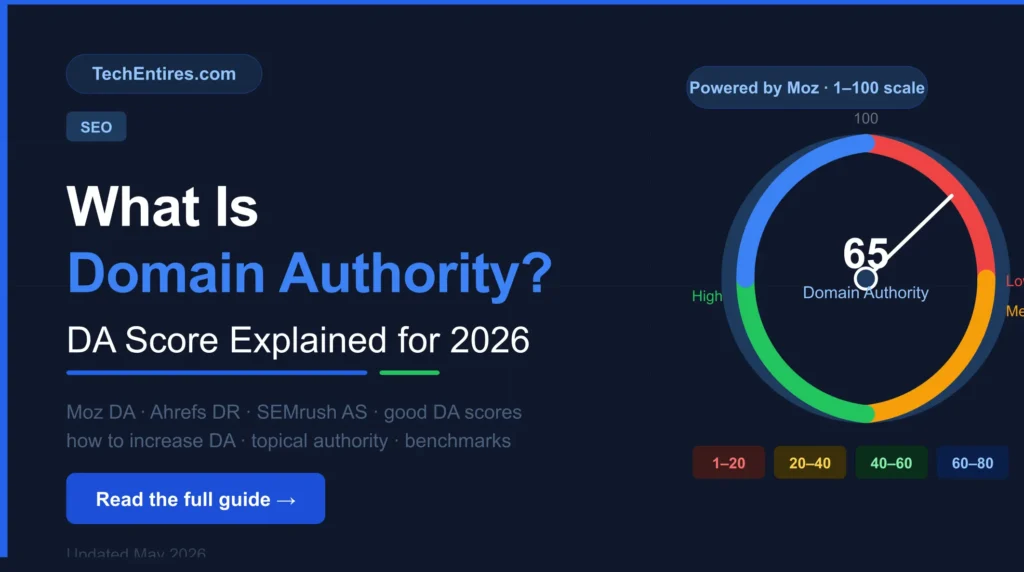
So, what is domain authority? Domain authority is a score from 1 to 100 created by Moz that predicts how well a website is likely to rank in search engine results. It is based primarily on the strength and quality of your backlink profile how many sites link to you and how trustworthy those sites are.
A score of 1 is a brand new site with no backlinks. A score of 100 belongs to sites like Wikipedia, Google itself, and major news publishers that have accumulated millions of high-quality links over decades.
Here is the critical thing most people miss: domain authority is a third-party metric. It is not a Google ranking factor. Google does not use the Moz DA metric, Ahrefs Domain Rating, or SEMrush Authority Score in its ranking algorithm.
These tools are all built by private companies using their own formulas and as confirmed by multiple independent sources in 2026, Google has never confirmed any of them as official signals. What DA gives you is a relative benchmark a way of comparing your site’s backlink strength to competitors.
Used correctly, it is genuinely useful. Used as a proxy for Google rankings, it leads you in the wrong direction.
Practical test: open your Google Search Console and check how well your pages actually rank. Then compare that to your DA score. You will quickly see that plenty of pages on low-DA sites outrank pages on high-DA sites for the same keywords. Topical depth and content quality consistently override raw DA.
How is domain authority calculated?
Moz uses a machine learning algorithm to calculate DA scores, updated approximately once per month. The calculation is based on data from Moz’s Link Explorer web index one of the largest link databases available outside of Google itself.
According to Moz’s own explanation of their algorithm: the calculation predicts how often Google is likely to use that domain in its search results. If Domain A appears more frequently in Google SERPs than Domain B, the model expects Domain A’s DA to be higher than Domain B’s. The key factors that feed into this calculation are:
| Factor | What it measures | Weight in calculation |
| Linking root domains | Number of unique domains linking to your site | Very high the primary driver of DA score |
| Total backlinks | Overall volume of links pointing to your domain | High but duplicate links from same domain count less |
| Link equity (link juice) | Authority passed from each linking page | High links from high-DA pages pass more value |
| Spam score Moz | Likelihood of spammy or manipulative links | Negative factor toxic links reduce DA |
| MozRank / MozTrust | Internal Moz metrics similar to PageRank | Medium feeds into the overall machine learning model |
One important point about DA score calculation: it is a relative scale, not an absolute one. Because established sites with large link profiles occupy the top end of the scale, it becomes progressively harder to increase your score as it rises.
Moving from DA 20 to DA 30 is far easier than moving from DA 60 to DA 70. The same number of new backlinks will have a noticeably smaller impact at higher DA levels because the top of the scale is already saturated with sites that have enormous referring domains counts.
Tool note: Moz DA, Ahrefs Domain Rating (DR), and SEMrush Authority Score all measure similar things backlink profile strength but use different formulas. SEMrush Authority Score consistently runs 15 to 20% lower than Moz DA on average. If you switch tools, your score will look different. This is expected. Pick one tool and track it consistently over time cross-tool comparisons are meaningless.
What is a good domain authority score for SEO in 2026?
This is the question most site owners actually want answered when they first look up what is domain authority. The short answer: it depends entirely on who you are competing with, not on any universal threshold.
That said, industry benchmark data from SEMrush and Linkscope’s 2024–2026 analysis gives practical reference points:
| DA range | What it indicates | Typical site type |
| 1–10 | Brand new domain, no established backlinks | New blogs, recently registered domains |
| 10–20 | Early growth stage, some backlinks building | Blogs 6–18 months old with consistent publishing |
| 20–40 | Growing authority, niche competitive | Established small to medium sites, 2–4 years old |
| 40–60 | Strong authority in most niches | Established businesses, active content programs |
| 60–80 | High authority, broadly competitive | Major industry publications, large media sites |
| 80–100 | Dominant authority | Wikipedia, national news sites, Google, Amazon |
A critical point that most DA guides miss: a lower DA does not automatically mean lower rankings. Research from Authority Hacker, analysed by Launchcodex in May 2026, found that sites with DA scores between 30 and 45 regularly outrank higher-DA competitors when they demonstrate stronger topical depth on a specific subject, better on-page relevance, or fresher content targeting informational intent.
This is exactly where the distinction between DA and topical authority matters most. Domain authority measures the strength of your backlink profile across the whole domain. Topical authority measures how comprehensively you cover a specific subject.
A DA 35 site that has published 30 deeply researched articles on one narrow SEO topic will often outrank a DA 60 general marketing site for SEO keywords because Google sees it as the more authoritative source on that specific topic.
The practical target: aim for a DA score at or above the average of the top 5 results for your target keywords not a universally ‘good’ number. Use your domain authority checker (Moz’s free tool, Ahrefs, or SEMrush) to check competitor scores for each keyword cluster you are targeting.
Domain authority vs Ahrefs Domain Rating vs SEMrush Authority Score
When you start checking your DA PA in SEO tools, you will quickly encounter three different authority metrics that all measure similar things but score them differently. Understanding the differences prevents confusion and bad benchmarking decisions.
| Metric | Tool | Scale | What it primarily measures | Best used for |
| Domain Authority (DA) | Moz | 1–100 | Backlink profile quality and quantity | General benchmarking, most widely referenced |
| Domain Rating (DR) | Ahrefs | 1–100 | Strength of referring domain backlinks | Link prospecting and outreach targeting |
| Authority Score (AS) | SEMrush | 1–100 | Backlinks + organic traffic + spam signals | Holistic authority assessment |
Ahrefs Domain Rating focuses heavily on the quality of links from other domains in Ahrefs’ own index. It tends to update more frequently than Moz DA sometimes daily which makes it more responsive to recent link building activity but also more volatile.
SEMrush Authority Score is considered harder to manipulate because it incorporates organic traffic signals alongside backlink data, making it more resistant to inflated scores from bought links.
The most important point: all three metrics score sites differently. A site with a Moz DA of 45 may have an Ahrefs DR of 38 and a SEMrush AS of 31. These differences are expected they are not errors. Pick one tool as your primary authority metric, track it monthly, and compare yourself to competitors using the same tool throughout.
Domain authority vs page authority what is the difference?
Once you understand DA, you will also encounter Page Authority and the distinction between the two matters for practical SEO decisions.
- Domain Authority (DA) measures the overall strength of an entire domain (techentires.com as a whole). It reflects the accumulated backlink authority across every page on the site.
- Page Authority (PA) measures the authority of a single specific page (techentires.com/what-is-domain-authority/). It reflects the backlinks pointing to that particular URL.
In practical terms: your DA score tells you how competitive your site is broadly. Your PA score for a specific page tells you how well-positioned that individual page is to rank. A high-DA site with a poorly linked internal page may have a strong DA but a weak PA for that page which is why internal linking matters so much as a distribution mechanism for authority.
Domain authority isn’t the whole story, on-page factors still matter enormously for individual page rankings. Our on-page SEO checklist covers what you control directly.
When evaluating competitors for a specific keyword, check the PA score of the actual pages you are competing against not just the DA of their domain.
A competitor with DA 70 but PA 12 on their ranking page is more vulnerable than a competitor with DA 45 but PA 38 on theirs. You can find this breakdown in any free domain authority checker including Moz’s free browser extension.
This is also why the internal linking strategy covered at directly impacts your page authority scores internal links distribute the DA your domain earns from backlinks to individual pages across the site.
How to increase domain authority what actually works in 2026
Knowing what is domain authority is only useful if you can act on it. Here are the six methods that reliably move DA scores in 2026 verified by consistent results across multiple site types:
1. Build links from more unique referring domains
The single most important factor in your DA score is the number of unique referring domains linking to your site. One hundred links from the same domain count as one root domain in Moz’s calculation.
One hundred links from one hundred different relevant domains is what moves the needle. Focus every link building effort on acquiring links from sites you do not already have links from variety of sources matters far more than volume from the same sources.
2. Earn links from high-DA sites in your niche
Not all referring domains are equal. A single link from a DA 75 industry publication contributes more to your backlink profile than dozens of links from DA 15 directories. Prioritise guest posting SEO opportunities, digital PR coverage, and resource page inclusion on established sites in your specific niche.
A link from a directly relevant DA 40 site in your topic area is worth more than a link from an unrelated DA 80 general news site.
Document sharing platforms like Scribd (DA 93) and SlideShare (DA 95) are an often-overlooked source of high-DA referring domains our guide to PDF submission sites covers the complete process of earning backlinks from these platforms.” Anchor text to hyperlink: “PDF submission sites”
3. Build topical authority alongside domain authority
In 2026, the relationship between DA and rankings is strongest when combined with deep topical authority. According to SearchAtlas data from January 2026, sites that publish at least 25 authoritative articles within one tightly connected content cluster see a 40 to 70% increase in keyword rankings for their target topic within three to six months.
This is because Google’s systems now assess topic expertise not just link volume when determining which sites deserve to rank.
The practical approach: use the pillar and cluster model covered in the guide on how to build a high traffic blog. Build your content around a few focused topic clusters and earn links within those clusters. DA growth that comes alongside topical authority growth compounds significantly faster than DA growth from random links.
4. Remove and disavow toxic backlinks
Your spam score Moz’s measure of potentially harmful links in your backlink profile directly suppresses your DA. Links from spammy directories, link farms, or irrelevant foreign-language sites can drag down your score even as you build new good links.
Run a monthly backlink audit using Moz’s free spam score checker or Ahrefs’ toxic link detection. Disavow confirmed toxic links through Google Search Console’s Disavow Tool. This is a protective measure as much as a growth one maintaining a clean backlink profile prevents penalties that are far harder to recover from than a lower DA score.
5. Create genuinely linkable content assets
The most sustainable way to increase domain authority over time is to publish content that earns links passively without outreach for every individual link. Original research, comprehensive guides with unique data, free tools, and content that takes a specific well-reasoned position on a debated topic all attract links naturally.
Every link you earn from genuinely good content contributes to both your DA and your topical authority simultaneously. A guide like the link building resource covers the full range of linkable content types that work in 2026.
6. Be patient DA growth has a realistic timeline
How long does it take to increase domain authority? Research from Authority Hacker, published by Launchcodex in May 2026, found that niche-focused sites reach DA 40 approximately 30% faster than generalist sites averaging 18 months compared to 26 months for broad-topic domains.
Even with aggressive link building, meaningful DA movement takes three to six months to register, because Moz’s algorithm updates scores approximately monthly and requires consistent signals to shift the machine learning model’s prediction.
Set a realistic target: aim to add three to five new referring domains per month from relevant, authoritative sources. Track your DA monthly using a domain authority checker. Review your backlink profile quarterly for toxic links.
At this pace, a new site can reach DA 30 within 12 to 18 months which is sufficient to rank competitively for most medium-competition SEO and blogging keywords.
One metric that predicts DA growth more reliably than anything else: the rate at which you are adding new unique referring domains per month. If that number is consistently growing even slowly your DA will follow within one to two monthly update cycles.
Does domain authority actually affect your Google rankings?
This is the most important question to answer clearly because the answer shapes how much attention you should give to this metric.
The direct answer: no, domain authority does not affect Google rankings because it is not a Google metric. Google has never confirmed using Moz DA, Ahrefs DR, or any third-party authority score in its algorithm. These are independently developed predictions, not inputs to Google’s ranking system.
The indirect answer: yes, the factors that determine your DA also determine a significant portion of your Google rankings. More high-quality referring domains means more trust signals for Google. Fewer toxic backlinks means a cleaner link profile. Better content means more naturally earned links.
The things you do to improve your DA are largely the same things Google rewards with higher rankings but the DA score itself is the measurement, not the cause.
The 2026 context: according to AI SEO statistics published by GoodFirms, sites with over 32,000 referring domains are 3.5 times more likely to be cited by ChatGPT, based on Ahrefs 2026 data.
This correlation confirms that the same underlying authority signals that push DA upward also improve visibility in AI-powered search results a channel that is increasingly important as AI Overviews resolve more informational queries without clicks.
The practical conclusion: track your DA as a benchmark and a competitive reference point not as a KPI you report to stakeholders. The KPIs that actually connect to business outcomes are organic sessions, keyword rankings, and conversions. Your DA score is a leading indicator of whether your link building and content strategy is working. See how to measure this properly in our content audit guide.
Frequently Asked Questions
What is domain authority in SEO?
Domain authority is a metric developed by Moz that predicts how likely a website is to rank well in search engine results. It scores domains from 1 to 100 based primarily on backlink profile strength the number of unique referring domains linking to the site and the quality of those links. It is a third-party prediction tool, not a Google ranking factor. Its value lies in competitive benchmarking and tracking progress over time.
What is a good domain authority score?
There is no universally good DA score it depends entirely on your competitors. For most niches, a DA between 30 and 50 is sufficient to rank competitively for medium-difficulty keywords when combined with strong content and topical authority.
The relevant question is not ‘what is a good score?’ but ‘what score do my page-one competitors have?’ Check the DA of the sites ranking on page one for your target keywords and aim to be within the same range. A DA 35 site with deep topical coverage of a specific niche will outrank a DA 60 generalist site for that niche’s keywords.
How is domain authority calculated by Moz?
Moz calculates DA using a machine learning algorithm that analyses data from its Link Explorer index. The primary inputs are: the number of unique linking root domains, the total volume of backlinks, the quality and authority of those linking pages (link equity), and a spam score based on the likelihood of manipulative links.
The model then predicts how frequently Google is likely to show that domain in search results sites predicted to appear more often get higher scores. Moz updates DA approximately once per month.
Does domain authority affect Google rankings?
Not directly. Domain authority is a Moz metric Google has never confirmed using it in its algorithm. However, the underlying factors that drive DA (quality backlinks from diverse referring domains, clean link profile, topical content depth) are the same factors that improve Google rankings.
Improving your DA by building legitimate, relevant links and creating genuinely useful content will almost always improve your Google rankings as a byproduct even though the DA number itself is not what Google is reading.
How long does it take to increase domain authority?
Meaningful DA movement typically takes three to six months of consistent link building to register, because Moz updates scores monthly and the machine learning model requires sustained signals to shift. Research by Authority Hacker found that niche-focused sites reach DA 40 in approximately 18 months on average, compared to 26 months for broad-topic generalist sites.
The most reliable predictor of DA growth speed is the rate at which you add new unique referring domains per month aim for three to five new domains per month from relevant, authoritative sources.
What is the difference between domain authority and page authority?
Domain authority measures the overall strength of an entire website’s backlink profile. Page authority (PA) measures the backlink strength of a single specific URL.
DA is a site-level metric used for broad competitive benchmarking. PA is a page-level metric used for evaluating how well a specific page can rank against direct competitors. When analysing a keyword you want to rank for, check the PA score of the actual pages ranking on page one not just the DA of their domains.
Domain authority vs topical authority which matters more in 2026?
Both matter but their relative importance has shifted. Domain authority (backlink strength) has always mattered. Topical authority how comprehensively and expertly your site covers a specific subject area has become increasingly weighted since Google’s Helpful Content updates.
In 2026, a site with DA 40 and deep topical coverage of a specific niche consistently outranks a DA 70 generalist site for keywords within that niche. The most effective strategy builds both simultaneously: earn links from relevant sources to grow DA while publishing a comprehensive content cluster to build topical authority.
