The honest answer to whether link building still matters
There is a version of this question that gets asked every year: is link building for SEO still worth the effort, or has Google finally moved past it? In 2026 the answer is clearer than it has ever been and it is not the answer most people expect.
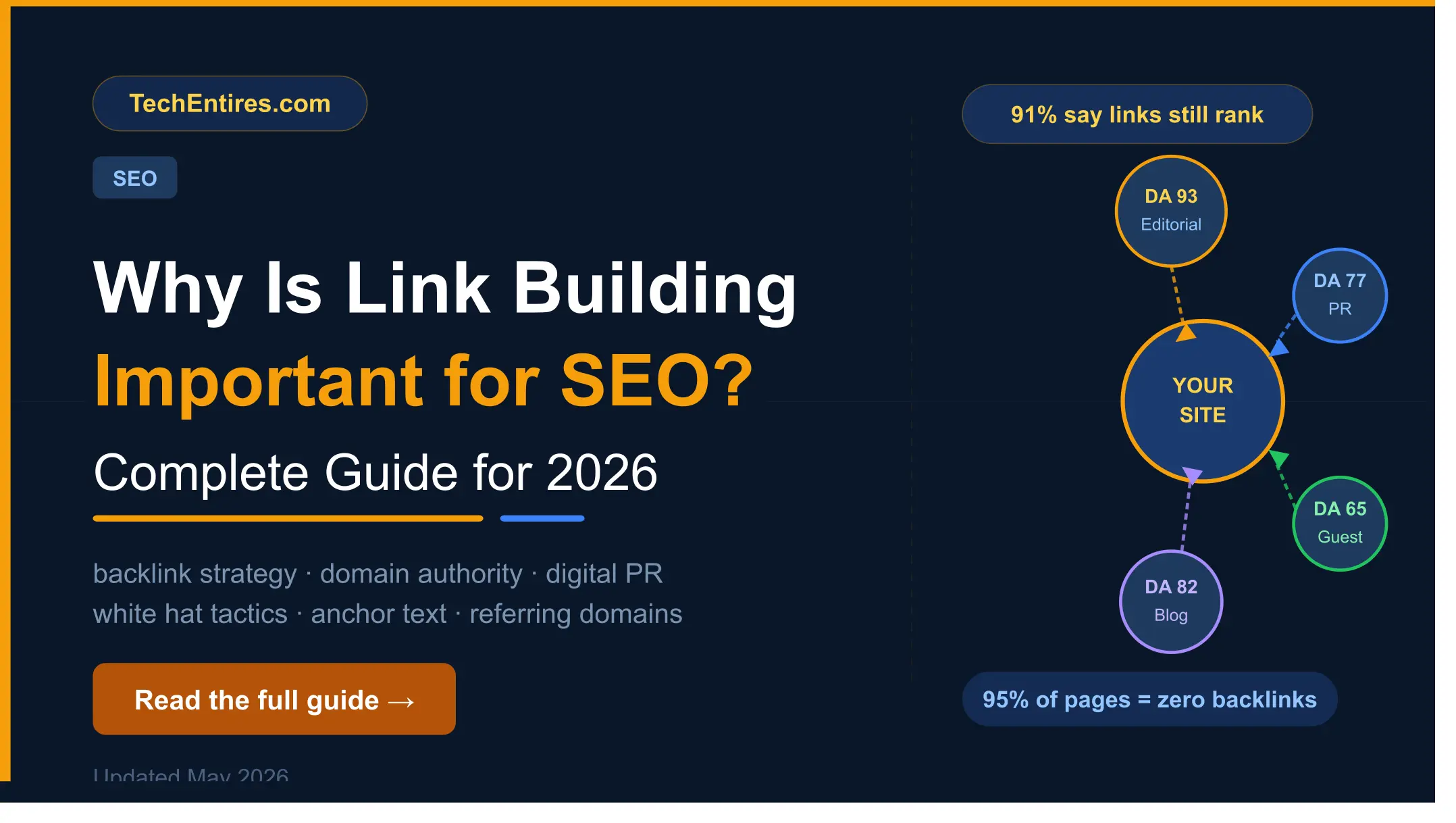
According to data published by DemandSage in April 2026, 95% of all pages on the internet have zero backlinks. Not low backlinks. Zero. And 94% of online content fails to earn any external links at all.
If link building did not matter, those numbers would be irrelevant. The fact that the pages with the most backlinks consistently occupy page one positions for competitive keywords confirmed repeatedly by Ahrefs correlation data tells you everything you need to know about the importance of link building in SEO in 2026.
Why is link building important for SEO in 2026 specifically? Because Google’s increased use of AI in its ranking systems has made trust signals more important, not less. A page that earns genuine links from authoritative, relevant sources is a page that has been validated by the wider web. In an environment where AI-generated content is flooding every niche, that external validation is how Google separates signal from noise.
This guide covers the full picture how links actually work as a ranking signal, why the importance of link building in SEO has shifted rather than declined, what a modern backlink strategy looks like, and the exact methods that still move rankings in 2026.
Quick reality check: pull up your Google Search Console and look at the top 5 positions for any competitive keyword in your niche. Then check the backlink profile of each result. What you will find almost without exception is that the pages ranking highest have the most links from the most trusted referring domains. This is not correlation. It is how Google’s ranking system is designed to work.
How backlinks actually work as a ranking signal
To understand the SEO backlinks importance, you first need to understand what a link actually tells Google. When a page on one website links to a page on yours, it is not just a navigation element. It is a signal to Google that says in effect ‘this content is worth referencing.’
Google’s original PageRank algorithm was built entirely on this idea. The more trusted pages that link to you, the more trust Google assigns to your page. In 2026 PageRank has evolved significantly, but the core mechanic remains: links are votes of confidence, and the authority of the voter matters enormously.
Three specific link signals that Google evaluates in 2026:
| Signal | What it means | Why it matters |
| Referring domains | Number of unique websites linking to you | More unique sources = stronger topical trust. 10 links from 10 different domains outperforms 100 links from 1 domain. |
| Link relevance | How closely the linking page relates to your topic | A link from an SEO blog to an SEO article passes far more ranking value than a link from an unrelated site. |
| Anchor text SEO | The clickable text used in the link | Descriptive anchor text reinforces what the target page is about. Over-optimised exact-match anchors are a spam signal. |
Ahrefs has consistently confirmed in their large-scale data studies that the more referring domains a page has, the more organic keywords it ranks for and the more traffic it receives. This is not a theory. It is the observable pattern across billions of indexed pages.
Why is link building important for SEO 6 specific reasons
1. Links help Google discover and index your content faster
Googlebot follows links. A new page with no links pointing to it may take weeks to be discovered through the standard crawl. A new page linked from a high-authority domain gets discovered within hours. This is one of the most immediately practical reasons to prioritise link building for SEO especially if you are publishing new content and need it indexed quickly.
Understanding how crawl budget works helps explain why internal and external links both accelerate indexing.
2. High quality backlinks transfer domain authority to your site
Every link from a trusted domain passes a portion of that domain’s authority to your page. This is how new sites with genuinely excellent content can climb past older sites by earning high quality backlinks from recognised sources. Domain authority is not a fixed ceiling. It is built, link by link, from the accumulated trust of the sites that reference you.
3. Links signal topical authority to Google’s AI systems
In 2026, topical authority the degree to which Google considers your site an expert on a specific topic has become one of the most important ranking factors. Links play a central role in building that topical authority.
When multiple sites within your niche link to you as a reference point, Google’s systems recognise you as part of the authoritative cluster on that topic. This is why a link from a relevant DA 40 site in your niche often outperforms a link from an unrelated DA 80 site.
4. Backlinks drive referral traffic directly independent of rankings
The SEO backlinks importance goes beyond rankings. A link on a high-traffic page in your niche drives real visitors to your site, completely independent of your Google rankings.
Referral traffic from link building tends to be high-intent the visitor clicked because the content was relevant to what they were already reading. That intent signals to Google that your page is worth the visit, which compounds into stronger engagement metrics over time.
5. Links remain the primary trust signal in an AI-saturated content environment
This is the specific reason why link building matters more in 2026 than it did three years ago. AI-generated content has made it trivial to produce thousands of well-formatted, keyword-rich pages.
Google’s challenge is distinguishing genuine expertise from machine-generated filler. E-E-A-T backlinks links from sources that demonstrate Google’s definition of experience, expertise, authoritativeness, and trustworthiness are the clearest external validation signal Google has.
A page that earns links from respected publications and established blogs in its niche has passed a test that an AI content farm cannot fake.
6. Competitor backlink profiles directly affect your ranking ceiling
For any commercially valuable keyword in 2026, the pages ranking on page one have established backlink profiles. Getting to page one without building your own backlink profile is only realistic for low-competition long-tail keywords. For medium and high-competition terms which are where the real traffic lives your link building strategy determines your ranking ceiling as much as your content quality does.
Real data point: 91% of SEO experts who participated in Aira’s link building study rated link building as effective or very effective in influencing search rankings. This number has remained consistent year over year despite repeated claims that links are losing their importance.
What has changed about link building in 2026 and what has not
Does link building still work in 2026? Yes but the tactics that work have shifted significantly. Understanding exactly what changed prevents you from wasting effort on approaches that Google now ignores or actively penalises.
| What NO LONGER works | What DOES work in 2026 |
| Mass outreach to irrelevant sites | Targeted outreach to relevant, authoritative sources in your niche |
| Buying links or using private blog networks (PBNs) | Digital PR earning links through original data, research, and news |
| Keyword-stuffed exact-match anchor text on every link | Varied, natural anchor text with branded, partial-match, and descriptive variations |
| High-volume link building from low-quality directories | Fewer, higher-quality links from topically relevant referring domains |
| Reciprocal link exchanges at scale | Guest posting SEO contributing genuine expertise to authoritative publications |
According to DemandSage’s 2026 link building research, digital PR is now the most widely adopted link building method used by 67.3% of marketers. The reason is simple: digital PR earns links naturally by creating content that journalists, bloggers, and researchers genuinely want to reference. It is white hat link building at its most scalable and sustainable.
How to build backlinks that actually improve your rankings in 2026
A modern link building strategy does not start with outreach. It starts with content because no outreach strategy compensates for content that nobody wants to reference.
Method 1 Create genuinely linkable assets
The most reliable way to learn how to build backlinks at scale is to create content that solves a specific problem better than anything currently ranking. Original research, comprehensive guides with unique data, comparison tools, and content that takes a clear, well-reasoned stance on a debated topic all attract links naturally.
Ask yourself before publishing: would an expert in my field reference this in their own writing? If the honest answer is no, the content is not yet link-worthy.
Method 2 Digital PR and data-driven outreach
Digital PR means creating newsworthy content original surveys, industry studies, or bold opinions backed by data and distributing it to publications and journalists in your niche.
A single link from a recognised publication can deliver more ranking benefit than fifty low-quality directory links. This approach builds a backlink profile that Google’s systems recognise as editorially earned, not artificially constructed.
Method 3 Guest posting SEO on relevant publications
Guest posting still works in 2026 when done with genuine quality and genuine relevance. Write for publications your target audience actually reads. Make the article genuinely useful not a thin wrapper around a link.
One strong guest post on a DA 60+ site in your niche, with a contextual link and natural anchor text back to your most relevant page, delivers measurable ranking impact within three to six weeks.
Method 4 PDF submission for passive backlinks from high-DA platforms
One of the most consistently underused link building strategies for bloggers and small websites is converting your best content into PDFs and submitting them to high-authority document sharing platforms. Scribd (DA 93), SlideShare (DA 95), and Issuu (DA 94) are all crawled by Google daily, pass genuine link equity, and require no outreach at all.
The complete platform list, DA scores, and step-by-step submission process is covered in the PDF submission sites guide
Method 5 Broken link building
Find pages in your niche that link to dead resources content that has been deleted or moved without a redirect. Use a tool like Ahrefs or Check My Links to identify these opportunities.
Then reach out to the page owner and suggest your content as a replacement. The conversion rate on this outreach is significantly higher than cold outreach because you are solving an existing problem for them, not asking for a favour.
Method 6 Internal linking to distribute backlink authority
Every external backlink you earn passes its authority to the specific page it points to. Internal linking then distributes that authority throughout your site.
A strong internal linking strategy ensures that the authority earned by your best-linked pages flows to every related post in your content cluster. This is one of the most overlooked amplifiers in link building for SEO. See the complete internal linking guide for the exact process.
Best link building strategies for small websites in 2026
The best link building strategies for small websites in 2026 are not about volume. A new or small site trying to build 100 links per month will produce mostly low-quality links that Google ignores or penalises. The better approach is five to ten genuinely earned links per month from relevant, trusted sources.
- Start with unlinked brand mentions. Search Google for your site or brand name and find pages that mention you without linking. These are the easiest outreach conversations you will ever have the site already knows you, already references you, and just needs to be asked to add the link.
- Leverage your expertise for journalist enquiries. Tools like Connectively (formerly HARO) and Qwoted connect journalists with expert sources. Responding to relevant queries with genuine, quotable insights earns editorial links from authoritative publications without any cold outreach.
- Build relationships before you need links. Comment genuinely on posts in your niche. Share others’ work. Engage on LinkedIn. When you eventually reach out with a link request or a guest post pitch, you are not a stranger.
- Target competitor backlink profiles. Use Ahrefs or SEMrush to see which sites link to your competitors. Every site that links to a competitor and is relevant to your content is a link you could potentially earn with the right pitch.
- Repurpose content into new formats. A blog post turned into a PDF guide, an infographic, a LinkedIn carousel, or a short video creates multiple new assets that can each earn links from different types of sites and platforms.
One thing to track from day one: your backlink profile diversity. A healthy backlink profile has links from many different referring domains across multiple content types blog posts, news articles, directories, document platforms. A profile that is mostly links from one type of source looks unnatural and under-delivers on ranking impact.
How many backlinks do you actually need to rank on Google?
This is one of the most searched questions in SEO and one of the hardest to answer honestly because the number varies enormously by keyword competition level.
| Keyword competition | Referring domains typically needed | Example keyword type |
| Low competition | 0–10 from relevant sources | Long-tail, specific, low-volume queries |
| Medium competition | 10–50 from varied referring domains | Standard informational keywords, 1K–10K/mo |
| High competition | 50–200+ from authoritative sources | Commercial, transactional, or broad keywords |
| Very high competition | 200+ including editorial, news, and niche authority sites | ‘Best X’, ‘Top Y’, high-volume competitive terms |
The more important question is not how many backlinks you need it is how many your top competitors have, and whether your content quality justifies earning that many. A page with 50 links from highly relevant, authoritative referring domains will outrank a page with 500 links from irrelevant low-quality sources every time.
For most small and medium blogs targeting medium-competition keywords, 20–40 high-quality referring domains pointing to your best pages is sufficient to reach page one provided the content is genuinely excellent and the on-page SEO is solid. You can track your progress on rewriting and improving existing pages to support this goal in our guide to updating old blog posts.
The link building mistakes that silently kill your rankings
- Building links before the content deserves them. Earning a link to a thin, poorly written page is wasted effort. Every link you build points to content Google will assess. The stronger the content, the more value each link delivers.
- Using the same anchor text on every link. If every backlink to your page uses the exact same keyword phrase as anchor text, it looks manipulative. Vary your anchor text branded, partial-match, and natural descriptive phrases to maintain a credible backlink profile.
- Ignoring referring domain diversity. 100 links from the same website deliver far less value than 10 links from 10 different relevant domains. Focus on the number of unique referring domains, not the total number of links.
- Chasing high DA over relevance. A DA 90 link from a completely unrelated industry is worth less than a DA 40 link from a directly relevant niche publication. Relevance beats pure authority metrics in 2026.
- Not monitoring your backlink profile. Spammy links can appear pointing to your site without your knowledge. Check your backlink profile monthly using Ahrefs, SEMrush, or Google Search Console. Disavow toxic links before they drag down your rankings.
- Treating link building as a one-time campaign. A link building strategy is not a project with an end date. Sites that consistently earn two to five new referring domains per month compound their authority over time. Sites that build links in bursts and stop see their advantage erode within six to twelve months.
Frequently Asked Questions
Why is link building important for SEO in 2026?
Link building for SEO remains important in 2026 because backlinks are still one of Google’s primary trust and authority signals. In an environment where AI-generated content has made it trivially easy to produce keyword-optimised pages, external links from credible sources are how Google distinguishes genuinely authoritative content from machine-generated filler.
According to Ahrefs data, there is a direct correlation between the number of referring domains a page has and the number of keywords it ranks for a relationship that has held consistent across multiple years of large-scale analysis.
How does link building affect SEO rankings?
Links affect SEO rankings through three primary mechanisms. First, they help Google discover and index pages faster. Second, they transfer trust and authority from linking domains to your page, raising its perceived quality in Google’s ranking systems. Third, they signal topical relevance links from related sites confirm that your content is recognised as authoritative within its specific subject area.
The combined effect is that pages with strong backlink profiles rank for more keywords, rank higher for target keywords, and maintain their positions more stably under algorithm updates.
Does link building still work in 2026?
Yes 91% of SEO experts in Aira’s most recent study rated link building as effective or very effective at influencing search rankings. What has changed is which tactics work.
High-volume low-quality link schemes, PBNs, and paid link networks are actively penalised by Google’s spam systems. White hat link building earning links through genuine content quality, digital PR, guest posting on relevant publications, and strategic outreach continues to deliver measurable ranking improvements.
How many backlinks do I need to rank on Google?
There is no fixed number it depends entirely on what your top-ranking competitors have. For low-competition long-tail keywords, strong content alone can rank with minimal backlinks.
For medium-competition keywords generating 1,000–10,000 monthly searches, 10–50 referring domains from relevant sources typically places you competitively on page one.
For high-competition commercial keywords, you are competing against pages with hundreds of authoritative referring domains, and your link building strategy needs to match that scale.
What is white hat link building?
White hat link building refers to acquiring backlinks through methods that comply with Google’s guidelines and reflect genuine editorial endorsement. This includes earning links through original research and data, guest posting on relevant publications with high-quality content, digital PR campaigns, and creating genuinely useful tools or resources that others reference naturally.
White hat link building produces a backlink profile that withstands algorithm updates because every link was earned on merit, not manufactured.
What is the difference between backlinks and internal links for SEO?
Backlinks (external links) come from other websites and signal trust and authority to Google from outside your own site. Internal links connect pages within your own site and distribute the authority earned from backlinks throughout your content. Both are essential.
A strong backlink profile without a good internal linking structure means authority earned by your best-linked pages does not flow to your other content. You can read the full internal linking strategy guide at techentires.com/3-best-ways-for-interlinking-blog-posts-in-wordpress/.
Can I rank on Google without any backlinks?
Yes for low-competition long-tail keywords where the search intent is specific and the existing competition is weak. It is genuinely possible for well-optimised content to rank page one for these queries with zero external links.
However, for any keyword with meaningful search volume and real competition, the pages consistently occupying page one positions have backlink profiles. Building a long-term organic traffic strategy purely without link building is possible but limits your ceiling to low-volume, low-competition terms.
“Once your link building starts improving your rankings, make sure you have a system to convert that new traffic our guide on how to convert blog traffic into sales covers 25 specific tactics.” Anchor text to hyperlink: “how to convert blog traffic into sales“
