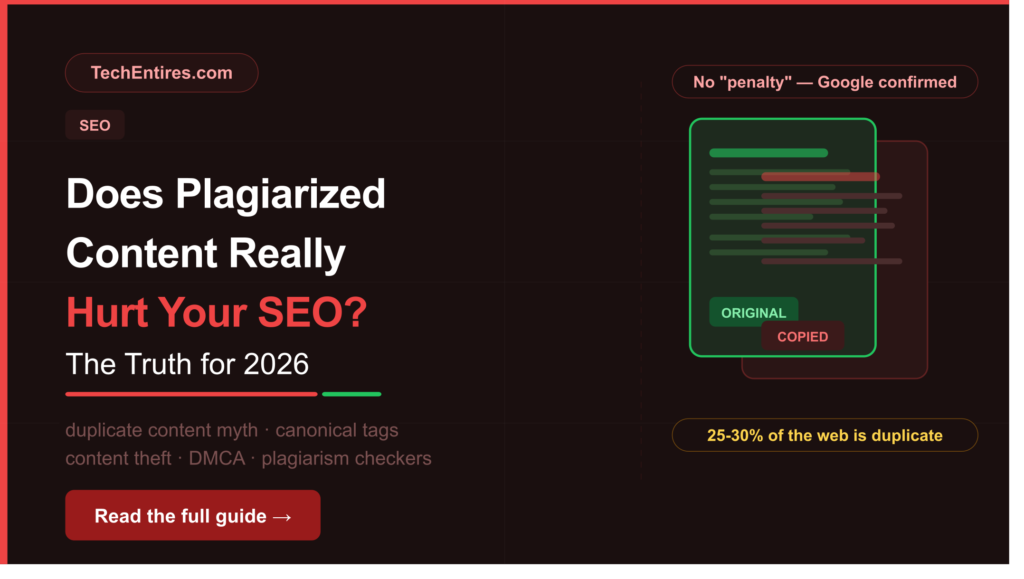
The myth that will not die and the real risk hiding behind it
If you search for plagiarized content SEO advice, you will find dozens of articles warning about a ‘Google duplicate content penalty’ that will tank your rankings overnight. This is one of the most persistent myths in SEO and it is, plainly, not true.
But the myth is dangerous precisely because it distracts from the real, documented risks that duplicate content SEO issues actually create.
Here is the fact, stated as directly as Google itself has stated it: there is no duplicate content penalty. John Mueller, Google’s longtime Search Advocate, has said this on the record at least a dozen times in a 2017 Webmaster Hangout, again in a 2020 SEO Office Hours session, and as recently as 2024 on Mastodon.
Google’s own Search Central documentation confirms it in writing: duplicate content on a site is not grounds for action unless the intent behind it is deceptive.
So why does plagiarized content can ruin your seo strategy remain such a common warning across the industry? Because while there is no automatic penalty, duplicate and plagiarized content absolutely can and does damage your search visibility through entirely different mechanisms signal dilution, crawl budget waste, lost backlink value, and in cases of genuine content theft, real spam policy violations that do trigger manual action.
This guide separates the myth from the mechanics, with sourced, verified information throughout.
The one-sentence summary to remember: Google does not punish you for having duplicate content. Google simply picks one version to show in search results and quietly filters out the rest. The damage comes from which version gets picked and it is not always yours.
Is there a Google duplicate content penalty? The direct answer
Is there a Google duplicate content penalty? No. This has been confirmed repeatedly and unambiguously by Google itself. According to gatilab.com’s April 2026 technical SEO analysis: ‘Duplicate content is not a Google penalty. Google picks one version as canonical and filters the others out of search results. That’s it.’
Google’s own Search Central documentation states this directly: duplicate content is ‘not grounds for action on that site unless it appears that the intent of the duplicate content is to be deceptive and manipulate search engine results.’
The key phrase is intent. Innocent, technical, or unintentional duplicate content which happens on nearly every website to some degree is not treated as a violation. It is treated as a housekeeping issue Google’s systems resolve automatically.
According to Ahrefs’ own research, published by Joshua Hardwick, Head of Content at Ahrefs: approximately 25 to 30% of the entire web consists of duplicate content.
If Google penalised every site with duplicate content, roughly a third of the internet would be penalised which is obviously not how search results actually work. Most duplicate content is boilerplate text, legal disclaimers, navigation menus, and technical URL variations that exist on virtually every functioning website.
A scraper outranking your original content often comes down to differences in domain authority see our full guide on what domain authority means .
What actually happens when Google finds duplicate content
Since there is no penalty mechanism, what does Google actually do when it encounters duplicate content SEO issues? The process is mechanical, not punitive:
- Google identifies similar or identical content across multiple URLs whether on your own site or across different domains.
- Google selects one version as canonical typically the version it judges to be the original source, the most authoritative, or the most complete. This selection uses signals like publish date, backlink profile, domain authority, and content depth.
- Google indexes and ranks the canonical version. The other versions are filtered out of search results not penalised, simply not shown, because showing multiple near-identical results would be a poor user experience.
- If your page is not selected as canonical, your version effectively disappears from search results for that content even though no penalty was applied to your site. The practical effect feels identical to a penalty, but the mechanism is entirely different.
This is precisely the mechanism behind why does duplicate content hurt SEO rankings, even without a formal penalty. According to Ahrefs’ research, the real consequences of duplicate content fall into specific, well-documented categories:
| Real consequence | What it means | Source |
| Backlink dilution | Links to the same content split across multiple URLs each carry less authority than if consolidated to one URL | Ahrefs / Joshua Hardwick |
| Crawl budget waste | Googlebot spends time crawling duplicate URLs instead of your unique, valuable content | Ahrefs / Joshua Hardwick |
| Signal dilution | Google cannot determine which version deserves ranking credit, weakening the overall signal | gatilab.com, April 2026 |
| Wrong version ranks | A scraper or syndication partner with higher authority may outrank your original content | originality.ai, 2025 |
Backlink dilution is one more reason consistent link building for SEO matters concentrate your authority on a single canonical URL rather than splitting it across duplicates.
When duplicate content does trigger real action content theft and spam
While there is no duplicate content penalty for innocent technical duplication, scraped content Google detection is a genuinely different category and it does trigger real consequences. This is where content theft SEO impact becomes serious.
According to gatilab.com’s analysis of Google’s spam policies, the practices that genuinely get penalised are spam violations, not duplicate content violations a critical distinction:
- Scraped content publishing other sites’ articles without permission or original commentary. This is plagiarism in the most direct sense, and it falls under Google’s spam policies rather than its duplicate content guidance.
- Auto-generated content at scale spinning articles, template-filled location pages with near-zero information gain, AI-generated bulk content published with no editing or genuine value added.
- Doorway pages multiple near-identical pages targeting slight keyword variations, all designed to funnel users toward the same single destination.
- Content farms thin, duplicate-ish content created purely for ad revenue with no genuine informational value for the reader.
Google’s September 2025 Spam Update specifically targeted content it considered repetitive or designed to manipulate rankings, with a notable impact on businesses running multiple near-identical location pages, according to pbjmarketing.com’s 2026 analysis. This update reinforces that the line Google actually enforces is manipulative intent not the mere existence of similar content.
The practical distinction that matters most: if someone scrapes and republishes your content without permission, that is a spam policy violation by the scraper not a duplicate content issue caused by you. You are the victim in that scenario, not the violator. The risk to your own SEO comes only if your site is the one doing the scraping, auto-generating, or manipulating.
How to check for duplicate content on your own site
Knowing how to check for duplicate content is the first practical step toward protecting your rankings. Most duplicate content issues are technical, not intentional caused by how your CMS or server generates URLs, not by anyone copying anything.
- Use Google Search Console’s coverage report. Look for the ‘Duplicate without user-selected canonical’ and ‘Duplicate, Google chose different canonical than user’ categories under Page Indexing. These reports show you exactly which of your own URLs Google considers duplicates.
- Run a site crawl with Screaming Frog (free up to 500 URLs). Look for identical title tags, meta descriptions, and near-identical body content across multiple URLs on your own domain common with tag archives, category pages, and pagination.
- Search a unique sentence from your content in quotation marks on Google. If pages from other domains appear with that exact phrase, your content has been scraped or republished elsewhere.
- Use plagiarism checker tools designed for content monitoring. Copyscape and Originality.AI both scan the web for copies of your published content and alert you when matches are found useful for ongoing monitoring rather than a one-time check.
How to fix duplicate content in WordPress
How to fix duplicate content WordPress sites most commonly encounter comes down to a small number of recurring technical causes. WordPress generates significantly more duplicate-content opportunities than custom-built sites because of how it structures archives, tags, and pagination.
Use canonical tags correctly
Canonical tag SEO is the primary fix for internal duplicate content. A canonical tag tells Google which version of a page is the authoritative one when multiple URLs show the same or similar content. In Yoast SEO or Rank Math, every post and page has a canonical URL field by default it points to itself, but you can set it manually for any page that duplicates content found elsewhere on your site, such as tag archives covering the same topic as a primary category page.
Consolidate tag and category overlap
WordPress sites commonly create duplicate content between tag pages and category pages that cover overlapping topics. Audit your taxonomy structure and either merge overlapping tags and categories, set canonical tags pointing from the thinner archive to the stronger one, or noindex tag archives entirely if they offer no unique value beyond a simple post listing.
Fix URL parameter duplication
Tracking parameters, session IDs, and sorting/filtering parameters can create dozens of URL variations for what is functionally the same page. Set canonical tags on parameterised URLs pointing to the clean version, and configure URL parameter handling in Google Search Console to clarify how each parameter should be treated.
Address pagination correctly
Paginated archive pages (page 2, page 3, etc.) of the same category or tag can read as thin, repetitive content to Google. Use rel=next/prev signals where supported by your theme, and consider noindexing pagination beyond page one if those pages add minimal unique value.
These same technical fixes also directly improve crawl budget waste see our complete guide on crawl budget SEO for the full diagnostic process.
What to do if your content is plagiarized
What to do if your content is plagiarized is a different problem entirely from internal duplicate content this is content theft SEO impact in its most direct form, and you have real options.
- Document the theft. Take screenshots and note the URL, date discovered, and the specific sections copied. This documentation is essential if you need to escalate the issue.
- Attempt direct contact first. Many cases of content theft are not malicious site owners sometimes republish content without realising the legal and SEO implications. A polite request to remove the content or add proper attribution and a link back resolves many cases quickly.
- File a DMCA takedown request if direct contact fails or the theft is clearly intentional. Google provides a formal DMCA takedown process through Search Console for removing infringing content from search results. This is a legal mechanism, not an SEO trick, and Google generally processes legitimate DMCA requests within a reasonable timeframe.
- Strengthen your own E-E-A-T signals to help Google correctly identify you as the original source. Clear author attribution, publish dates, and internal links connecting your content to your broader site authority all help Google’s canonicalization process favour your version over a scraper’s.
According to originality.ai’s analysis: when someone plagiarizes your website content, the effects ripple beyond search rankings alone readers who encounter the same content on multiple sites often lose trust in both, since duplicated content damages credibility regardless of which site published first in the reader’s eyes. Acting quickly protects both your rankings and your brand reputation.
Preventing duplicate content before it becomes a problem
The most effective duplicate content SEO strategy is prevention rather than cleanup. A few structural habits prevent the majority of issues before they start:
- Write genuinely original content for every post. This sounds obvious, but content produced by inexperienced freelance writers or low-effort AI generation without editing is the most common source of unintentional near-duplicate content across a site’s own pages.
- Set up your CMS correctly from the start. Configure canonical tags, XML sitemaps, and URL structures properly when building or migrating a site most technical duplicate content issues stem from default CMS settings that were never reviewed.
- Monitor for content theft proactively. Running periodic checks with a plagiarism checker tool catches scraping early, before a copied version has time to accumulate backlinks or authority that could outrank your original.
- Build a strong internal linking structure. Pages well-connected within your own site’s content architecture send clearer signals to Google about which version of content is the authoritative, intentional one. See the complete internal linking guide .
If you suspect older posts on your own site overlap or compete with each other, our guide on how to rewrite old blog posts covers exactly how to merge and consolidate them.
Frequently Asked Questions
Is there a Google duplicate content penalty?
No. Google has confirmed repeatedly, including statements from John Mueller in 2017, 2020, and as recently as 2024, that there is no duplicate content penalty. Google simply selects one version of duplicate content as canonical and filters the others from search results. This is a mechanical filtering process, not a punitive action confirmed directly in Google’s own Search Central documentation.
Does duplicate content hurt SEO rankings?
Indirectly, yes even without a formal penalty. Duplicate content can cause backlink dilution (links split across multiple URLs instead of consolidating authority), wasted crawl budget, and signal dilution that makes it harder for Google to determine which version deserves to rank. If a scraper’s version of your content accumulates more authority than your original, their version may outrank yours which feels like a penalty but is actually a canonicalization outcome.
How do I check for duplicate content on my site?
Check Google Search Console’s Page Indexing report for ‘Duplicate without user-selected canonical’ issues. Run a Screaming Frog crawl to find identical titles, meta descriptions, and body content across your own URLs. Search unique phrases from your content in quotes on Google to find external copies. Use a dedicated plagiarism checker tool like Copyscape or Originality.AI for ongoing monitoring.
What should I do if my content is plagiarized?
Document the theft with screenshots and URLs, attempt direct contact with the site owner requesting removal or attribution first, and file a DMCA takedown request through Google Search Console if direct contact fails. Strengthen your own E-E-A-T signals author attribution, publish dates, internal linking to help Google’s canonicalization process correctly identify you as the original source.
How do I fix duplicate content in WordPress?
Set canonical tags correctly using Yoast SEO or Rank Math, consolidate overlapping tag and category pages, fix URL parameter duplication through Search Console’s parameter handling settings, and address pagination with rel=next/prev signals or noindex tags where appropriate. Most WordPress duplicate content issues stem from default taxonomy and archive settings rather than intentional content duplication.
What is the difference between duplicate content and plagiarism for SEO purposes?
Duplicate content refers to identical or highly similar content existing in more than one location, often unintentionally, due to technical CMS behaviour or legitimate syndication. Plagiarism specifically means content theft copying someone else’s work without permission or attribution.
Google’s duplicate content guidance covers the former with no penalty mechanism. Plagiarism and scraped content fall under Google’s spam policies, which can trigger genuine manual actions when intent to deceive or manipulate is evident.
Can AI-generated content cause duplicate content issues?
Yes. AI-generated similarity occurs when content created by AI tools across multiple pages becomes too similar in structure, phrasing, or substance, even without being word-for-word identical. Google’s spam policies specifically flag auto-generated content published at scale without genuine editing or added value as a spam violation, distinct from ordinary duplicate content. Using AI as a drafting tool while ensuring genuine editing, original examples, and first-hand insight avoids this risk.
