Picking a content management system used to come down to a handful of well-known names.
That’s still mostly true, but the gap between the leader and everyone else has been narrowing, slowly, but consistently, for the past few years. Here’s where the CMS market actually stands in 2026, and what’s driving the shifts.
Quick Answer: Top CMS Platforms by Market Share (2026)
Based on current W3Techs data, among websites using a known CMS:
- WordPress: ~59-60% of the CMS market (~42% of all websites)
- Shopify: ~6-7% of the CMS market
- Wix: ~4-6% of the CMS market
- Squarespace: ~3-3.5% of the CMS market
- Joomla: ~1.7-2.4% of the CMS market
- Drupal: ~1-1.8% of the CMS market
- Webflow: ~1-1.2% of the CMS market
- BigCommerce: ~3% of the eCommerce CMS market
- Blogger (Blogspot): under 1% of all websites
- OpenCart: under 1% of all websites, concentrated in eCommerce
(Figures vary slightly by data source and measurement method, see the note on methodology below.)
What is Market Share? WordPress Still Leads, But the Gap Is Narrowing
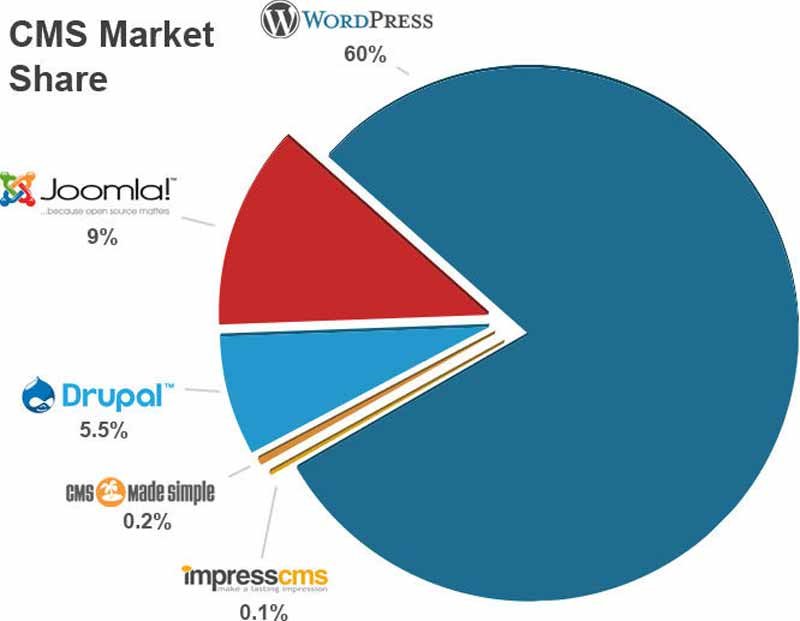
WordPress remains the dominant CMS by a wide margin, powering somewhere between 42-43% of all websites globally and roughly 59-60% of websites running a known CMS, according to W3Techs. No other platform comes close to that combined reach.
That said, the story isn’t pure dominance anymore. WordPress peaked at around 43.6% of all websites in mid-2025 and has since eased down slightly. It’s the platform’s first sustained, multi-year share decline, not a collapse, but a real shift after two decades of near-uninterrupted growth.
The drop isn’t primarily existing sites migrating away; it’s newer sites increasingly launching on SaaS builders like Wix and Shopify instead of choosing WordPress by default.
WordPress’s strength is still real: it’s free, open-source, backed by tens of thousands of plugins and themes, and flexible enough to run anything from a personal blog to an enterprise publication.
WooCommerce, which runs on top of WordPress, also remains the most widely used eCommerce platform by store count, more stores run WooCommerce than any single competitor, even though Shopify leads on total transaction volume.
1. Shopify | The Clear #2, and the Fastest-Growing at Scale

Shopify holds roughly 6-7% of the CMS market and has been the most consistent gainer among major platforms.
Unlike Wix, which has grown fast off a small base, Shopify’s growth has come with genuine scale, its 2025 revenue exceeded $11.5 billion, and it now processes more gross merchandise volume than WooCommerce, even though WooCommerce has more individual stores.
Shopify’s focus on eCommerce specifically, built-in payments, inventory, shipping, is a big part of why it keeps taking share from general-purpose CMS platforms for anyone building a store first and a content site second.
2. Wix | The Fastest-Growing by Percentage

Wix has posted the steepest growth curve of any major CMS, up roughly 30%+ year-over-year by some measures, and has grown from a near-negligible share a decade ago to a legitimate top-three position today.
Its appeal is straightforward: no-code, hosted, and built for people who want a working website without touching a plugin ecosystem or worrying about updates and hosting.
3. Squarespace, Joomla, and Drupal | Steady, Declining, and Enterprise-Focused

Squarespace holds a stable 3-3.5% of the CMS market, appealing to a similar audience as Wix but leaning more toward design-forward small business and portfolio sites.
Joomla and Drupal, by contrast, have both been losing ground for years, combined, they’ve fallen from a double-digit share to roughly 3% today. Drupal in particular has held on more successfully in the enterprise and government space, where its flexibility and security track record still matter more than ease of use for a general audience.
What’s Actually Driving the Shift
A few consistent patterns show up across current CMS market data:
- SaaS builders are winning new sites. Over half of new eCommerce stores now launch on hosted platforms rather than self-hosted CMS software, since payments, hosting, and updates are handled for you.
- Performance is a real competitive factor. WordPress sites pass Core Web Vitals mobile checks at a noticeably lower rate than platforms like Shopify or newer builders like Duda, though a well-optimized WordPress site can perform just as well; the gap reflects average configuration, not a hard platform ceiling.
- Open-source platforms are consolidating around WordPress. Joomla and Drupal’s declines haven’t benefited each other, they’ve mostly lost ground to hosted alternatives, leaving WordPress as the dominant open-source option almost by default.
Security remains a real consideration. WordPress’s scale makes it a bigger target, and the vast majority of reported vulnerabilities come from third-party plugins rather than WordPress core itself, a good reminder to keep plugins updated and minimal. (Our guide on securing a WordPress site from hackers covers the specifics.)
A Note on Methodology
CMS market share numbers vary meaningfully depending on how they’re measured, W3Techs samples the top 10 million websites by traffic rank, while HTTP Archive’s Core Web Vitals data draws from a different, mobile-weighted sample.
That’s why you’ll see WordPress’s “share of all websites” reported anywhere from roughly 33% to 43% depending on the source and methodology. The relative rankings (WordPress first by a wide margin, Shopify and Wix next) are consistent across sources even when the exact percentages differ.
Which CMS Should You Actually Choose?
Market share is a useful signal of ecosystem size and long-term support, but it shouldn’t be the deciding factor on its own. In practice:
- WordPress makes sense if you want maximum flexibility, content-heavy publishing, or a huge plugin ecosystem, and you’re comfortable handling (or hiring for) hosting, updates, and security.
- Shopify is the stronger default if you’re building a store first, since payments, inventory, and checkout are handled natively.
- Wix or Squarespace fit best if you want a fully hosted, no-code experience and don’t need deep customization.
- Drupal remains a solid enterprise choice where complex permissions, security requirements, or custom architecture matter more than ease of use.
If you’ve landed on WordPress, our guides on the best WordPress plugins for 2026 and securing a WordPress site from hackers cover the two things worth getting right early.
Frequently Asked Questions
What is the most popular CMS in 2026?
WordPress remains the most popular CMS by a wide margin, powering roughly 42-43% of all websites and around 59-60% of websites running a known CMS, according to W3Techs data.
Is WordPress losing market share?
Yes, modestly. WordPress peaked at around 43.6% of all websites in mid-2025 and has since declined slightly. It’s the first sustained multi-year decline in WordPress’s history, driven mainly by faster growth from SaaS builders like Wix and Shopify rather than existing sites migrating away.
What is the second most popular CMS?
Shopify holds the #2 position among platforms with a detectable CMS, at roughly 6-7% of the CMS market, ahead of Wix and Squarespace.
Why do CMS market share numbers vary between sources?
Different research firms sample different sets of websites and use different detection methods, some focus on top-traffic sites, others sample more broadly. The exact percentages differ, but the overall rankings stay fairly consistent across sources.
Is Wix or WordPress better for a small business?
It depends on the need. Wix suits businesses that want a fully hosted, no-code setup with minimal ongoing maintenance. WordPress suits businesses that want more customization, a larger plugin ecosystem, or plan to scale content significantly over time.
