If you’ve searched for Instagram growth tips recently, you’ve probably noticed most advice still reads like it was written in 2021, post consistently, use hashtags, engage with your audience.
None of that is wrong exactly, but Instagram’s algorithm has changed enough in 2026 that following outdated advice can actually work against you, sometimes actively suppressing reach instead of building it.
This guide replaces our older, scattered Instagram posts with one complete resource, covering profile optimization, content strategy, engagement, hashtags, influencer marketing, ads, and performance tracking, all updated for how Instagram actually ranks content right now.
Whether you’re building a personal brand or growing a business account, the goal is the same: understand what the algorithm rewards today, then build habits around that instead of chasing outdated tricks.
Consider this the single reference to bookmark instead of piecing together advice from several older, disconnected posts on the same topic.
How the Instagram Algorithm Actually Works in 2026
Instagram doesn’t run on a single algorithm. Feed, Reels, Stories, and Explore each rank content using different signals, so a technique that boosts your Reels reach won’t necessarily do anything for your Feed posts.
Understanding the current ranking logic matters more than any individual “hack,” because a single insight about how content gets ranked will outlast a dozen trendy tricks that stop working in a few months.
Views is now the universal metric
One of the bigger shifts in 2026: Instagram unified how it measures performance across formats. Reels, Stories, photos, and carousels are all now measured primarily through views, replacing the patchwork of format-specific metrics that made comparing content types confusing.
Practically, this means a strong photo post and a strong Reel can now be compared on the same terms, which makes it easier to see what’s actually working across your whole account instead of judging each format separately.
Second-chance distribution
Instagram’s algorithm now does something worth planning for: it re-shows posts to people who scrolled past them without engaging the first time.
This means a slow start doesn’t necessarily doom a post, content that builds engagement gradually over several days can still get a second wave of reach, which rewards posting things with lasting value over purely time-sensitive content.
Original content wins
Instagram has gotten noticeably more aggressive about down-ranking content that looks recycled from other platforms, reposted TikToks with visible watermarks being the most obvious example.
The algorithm favors content made specifically for Instagram, with formatting, pacing, and captions built for how people actually use the app. If you’re repurposing content from another platform, re-editing it to remove watermarks and adjusting the pacing for Instagram’s audience is no longer optional if you want real reach.
Across all formats, the ranking signals that matter most are watch time, saves, and shares, not raw likes and not follower count. A post that gets saved and shared by a smaller, highly engaged audience will consistently outperform a post that gets a lot of likes from people who never interact with your content again.
This is worth internalizing before planning any content calendar, since it changes what “good” content actually looks like, a post designed to be quickly liked and scrolled past is optimizing for the wrong outcome entirely.
Optimizing Your Instagram Profile to Maximize Your Presence
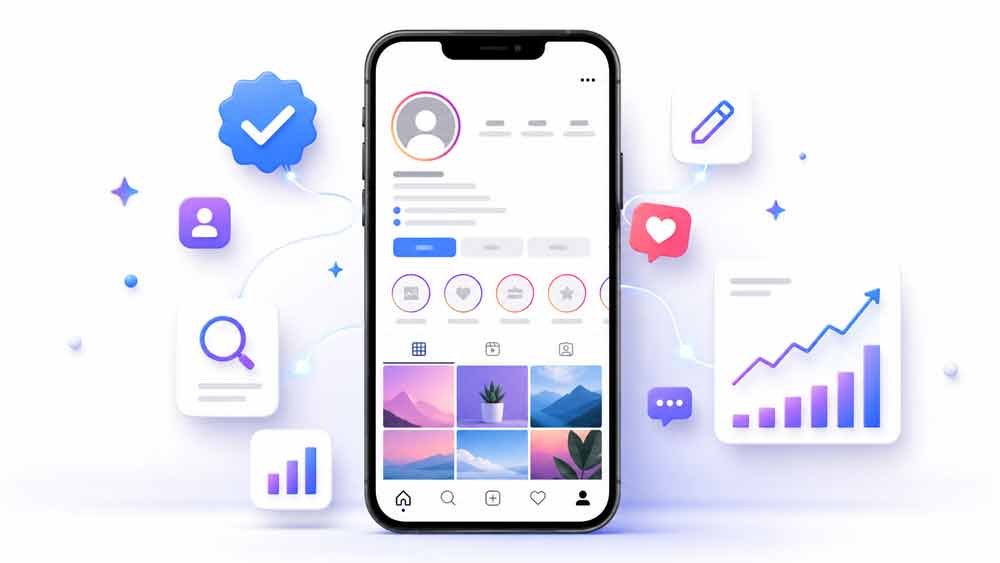
Your profile is still the first real impression a potential follower gets, and it hasn’t lost its importance even as the algorithm has changed around it. A few fundamentals still matter:
- A clear, benefit-focused bio. Say exactly what your account offers in the first line, since that’s what shows before someone taps to expand it. Working a relevant keyword or two into your bio naturally helps people find you when searching within the app.
- A recognizable profile photo. Whether it’s a logo or a face, it needs to be instantly identifiable at thumbnail size, since that’s how most people will actually see it.
- A working link and clear call-to-action. If you’re sending people anywhere off Instagram, make the destination and the specific reason to click both immediately obvious.
- Converting to a Business or Creator account. Both unlock Instagram Insights, which is the single most useful free tool for understanding what’s actually working on your account.
Keep your profile updated as your content strategy evolves. A bio describing a focus you dropped six months ago quietly undermines the trust you’re trying to build with new visitors.
It’s worth reviewing your profile every quarter with fresh eyes, imagine landing on it for the first time and ask honestly whether it’s still an accurate, compelling first impression of what your account actually offers today.
Building an Instagram Content Strategy That Gets Seen
Reels first, but not Reels only
Reels remain the strongest format for organic reach in 2026, the algorithm actively pushes them to people who don’t already follow you, which makes Reels the most reliable way to reach new audiences rather than just serving your existing followers.
That said, a Reels-only strategy misses the second-chance distribution advantage that photo posts and carousels benefit from, and it misses the deeper, slower engagement that comes from a strong photo carousel someone saves and revisits.
A balanced content mix, Reels for reach, carousels for saves and depth, Stories for daily connection, consistently outperforms betting everything on one format.
Content pillars and consistency
Random posting without a plan is one of the most common reasons accounts stall. Building 3–4 recurring content pillars, categories your account consistently covers, gives your audience a reason to expect specific value from you, and it makes planning content dramatically easier since you’re not starting from a blank page every time you sit down to plan the week’s posts.
Posting 4–7 times a week to your main grid, with daily Stories, is a reasonable baseline for most accounts, but the specific schedule matters less than sustainability.
A realistic schedule you can actually maintain for months beats an ambitious one you abandon after three weeks. Check your own Instagram Insights to find when your specific audience is most active, general guidance points to mid-morning through early afternoon on weekdays, but your account’s real data will always be more accurate than a generic benchmark. Treat that benchmark as a starting point to test against your own numbers, not a rule to follow blindly.
Engagement Techniques That Actually Build Loyalty

Engagement in 2026 means more than responding to comments, though that’s still a baseline expectation. Hosting Q&A sessions, using interactive Stories stickers like polls and questions, and directly featuring user-generated content all give your audience real reasons to interact rather than passively scroll past your posts.
Running a contest built around user-generated content is one of the most reliable ways to generate that content on demand, see our winning Instagram contest strategies guide for how to structure one that actually grows your account instead of attracting one-time prize hunters.
Personalizing responses matters more than it sounds. Addressing people by name and responding to the actual substance of their comment, instead of a generic “thanks for reading!”, builds a noticeably stronger connection, and it signals to other viewers that your account is genuinely present, not just broadcasting.
Engagement is also a two-way habit. Spending a few minutes actively liking and commenting on other accounts’ posts before and after you publish your own tends to improve your reach on that post, likely because it signals active participation to the algorithm rather than passive posting.
Stories deserve their own attention here, separate from feed and Reels engagement. Because Stories disappear after 24 hours, they’re the lowest-pressure format for daily connection, a quick behind-the-scenes moment, a poll, a question sticker, and consistent daily Stories keep your account visible in the Stories tray even on days you don’t post to your main grid.
Accounts that treat Stories as an afterthought are leaving one of the easiest daily touchpoints with their audience unused.
Hashtags, Location Tags, and Discoverability in 2026
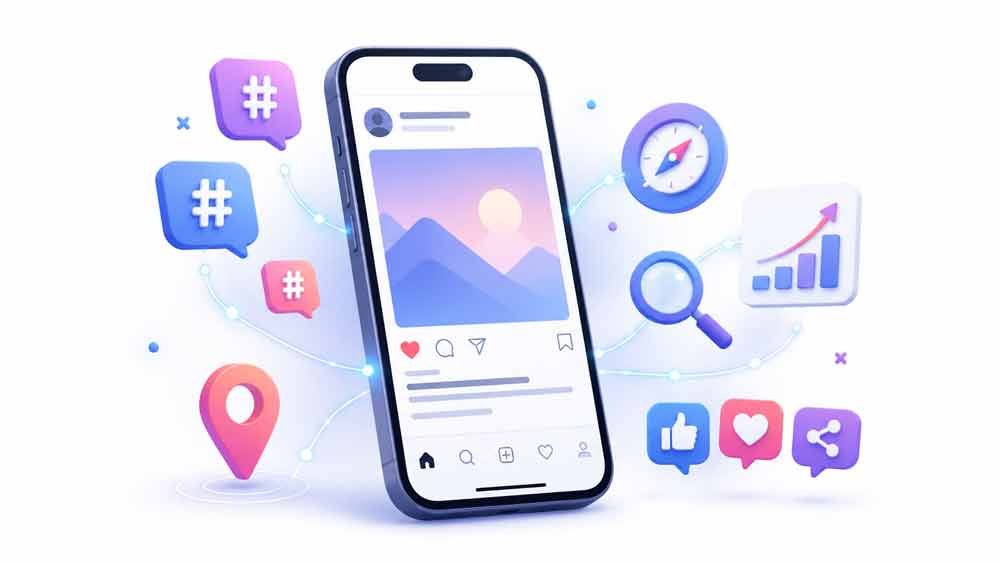
Hashtags still help content get discovered by people searching specific topics, but the era of stuffing 30 hashtags into a caption is over, a handful of relevant, well-researched hashtags that genuinely match your content and audience outperform a long generic list. Avoid hashtags that have been flagged or banned, since they can quietly suppress your reach rather than boost it.
Location tags remain useful for connecting with local audiences and improving your odds of appearing on the Explore page for people nearby. Use them when they’re genuinely relevant to the content, a location tag on unrelated content reads as spam and does little for actual reach.
The same logic applies to hashtags: a niche-specific hashtag with a smaller but genuinely interested audience often outperforms a massive, generic one where your post disappears within minutes.
Repurposing Blog Content Into Instagram Posts
If you’re already running a blog, your existing articles are one of the most underused sources of Instagram content.
A single how-to post can become a multi-slide carousel breaking the process into steps, a Reel walking through the highlights, or a series of Stories answering the specific questions readers ask in your comments section. This isn’t just a time-saver, it also reinforces the same content across two channels, which strengthens both.
Free AI tools can speed up this repurposing process considerably, turning a long-form article into a tight carousel outline or a short video script is exactly the kind of task a free-tier AI writing assistant handles well, leaving you more time for the parts that need a real human touch: the actual filming, the specific brand voice, and the details only you know about your own audience.
Growing Brand Exposure Through Influencer Marketing

Influencer partnerships remain one of the more effective ways to reach a highly targeted, pre-engaged audience quickly. The key decision is relevance over raw follower count, an influencer with a smaller but genuinely engaged, niche-relevant following typically drives better results than a larger account with a broad, less relevant audience.
Set clear goals and specific deliverables before a partnership starts, and track the actual performance, engagement rate, click-throughs, conversions, rather than judging success by reach alone.
That data is what makes future influencer decisions easier and helps you identify which partnerships are worth repeating. A single strong partnership with a well-matched micro-influencer often delivers better long-term value than several scattered collaborations with accounts chosen mainly for their follower count.
Instagram Ads: When and How to Use Them
Instagram ads are worth adding once you have organic content that’s already proving itself, boosting a post that’s already performing well organically consistently outperforms building an ad campaign around untested content.
Strong, scroll-stopping visuals and a clear call-to-action remain the fundamentals of an effective ad, and testing different creative and targeting combinations against each other is the fastest way to find what actually converts for your specific audience.
Start small when testing. Running several low-budget variations of the same core ad, different opening frame, different headline, different call-to-action, and letting the data pick a winner before scaling spend is a far more reliable path to a profitable campaign than committing a large budget to a single untested creative upfront.
Turning Engagement Into Business Growth
None of the above matters if it doesn’t eventually connect to a real business outcome. Vanity metrics like follower count and likes are useful signals, but they don’t demonstrate business impact on their own.
Connecting Instagram performance to actual outcomes, website clicks, email signups, sales, is what justifies continued investment in the platform and shows whether your strategy is genuinely working, not just generating activity.
For accounts monetizing through product sales, tagging products directly in posts and Reels shortens the path from discovery to purchase, and it’s worth pairing with a broader monetization strategy, the same long-tail keyword thinking that works in affiliate marketing strategies applies just as well to Instagram captions, since a specific, searchable caption reaches a more purchase-ready audience than a generic one.
Building a simple funnel around your best-performing organic content extends its value well past the initial post.
A carousel that consistently earns saves is a signal that people want to reference it again later, pairing that post with a linked lead magnet or email signup captures readers at the exact moment they’ve decided your content is worth keeping.
Tracking Performance: Metrics That Actually Matter in 2026
With views now the standard metric across formats, tracking performance is more straightforward than it used to be, but the metrics worth prioritizing haven’t changed: watch time, saves, shares, and follower growth relative to your posting volume.
Website clicks and actual conversions matter more than impressions for any account with a business goal behind it.
Instagram Insights covers the basics for free, and it’s enough for most single-account creators and small businesses. Third-party analytics tools add value once you’re tracking competitors, managing multiple accounts, or need deeper historical trend data than Instagram’s native tools provide.
Whichever tool you use, checking performance on a consistent schedule, weekly for fast-moving accounts, monthly for slower ones, matters more than which specific tool you pick, since the value comes from noticing trends over time, not from a single snapshot.
Instagram Growth Checklist for 2026
Run through this before finalizing a content calendar, and revisit it quarterly as the algorithm continues to evolve:
- Profile bio clearly states what you offer, with a relevant keyword worked in naturally
- Account converted to Business or Creator to unlock Instagram Insights
- Content mix includes Reels, carousels, and Stories, not just one format
- 3–4 content pillars defined and posted on a sustainable, repeatable schedule
- Hashtags relevant and specific, not a generic stuffed list
- Location tags used only when genuinely relevant to the content
- Engagement includes proactive commenting on other accounts, not just replying
- Influencer partnerships evaluated on relevance and engagement rate, not follower count alone
- Ads built around content that’s already proven organically
- Performance tracked against real business outcomes, not just vanity metrics
Common Mistakes That Kill Instagram Reach
Reposting content from other platforms without re-editing it. Visible watermarks and mismatched pacing get down-ranked — always re-edit for Instagram specifically.
Chasing likes instead of saves and shares. The algorithm weighs saves and shares more heavily, and content built purely for quick likes rarely earns either.
Stuffing captions with dozens of generic hashtags. A handful of relevant, specific hashtags consistently outperforms a long, unfocused list.
Posting without a content pillar strategy. Random, unplanned posting makes it hard for your audience to know what to expect from you, and it makes your own planning harder too.
Judging success by follower count alone. Vanity metrics don’t demonstrate business impact, track clicks, conversions, and engagement quality instead.
Treating Stories as an afterthought. Skipping daily Stories gives up one of the easiest, lowest-effort ways to stay visible in your audience’s Stories tray between main grid posts.
A Real-World Scenario
A small skincare brand was posting daily but saw follower growth stall for months. Their content was well-shot, but it was a mix of reposted TikToks and generic product photos with 25+ hashtags crammed into each caption.
After restructuring around three content pillars, ingredient education, real customer results, and behind-the-scenes routine content, and cutting hashtags down to eight genuinely relevant ones, engagement on individual posts more than doubled within a month. Nothing about the product itself changed, and the team didn’t increase their posting frequency or budget.
The difference was posting content built specifically for Instagram’s current ranking signals instead of recycled, generic material that happened to look fine on the surface.
The brand also started tracking saves specifically instead of just likes, and noticed their ingredient-education carousels were being saved at nearly three times the rate of their product photos, a clear signal about which content pillar to lean into further. That single metric shift changed their entire content calendar for the following quarter.
Frequently Asked Questions
How does the Instagram algorithm work in 2026? Instagram runs multiple algorithms, one each for Feed, Reels, Stories, and Explore, that rank content based on watch time, saves, shares, and how often you interact with a given account, rather than just likes or follower count. Views is now the unified metric across all content formats, replacing the older, format-specific metrics that made comparing a Reel to a photo post confusing.
How often should I post on Instagram in 2026? A common baseline is 4–7 posts a week to your main grid with daily Stories, but consistency and sustainability matter more than hitting an exact number. A realistic schedule you can maintain long-term outperforms an ambitious one you abandon after a few weeks, and checking your own Insights data will tell you more about optimal timing than any generic benchmark.
Are Reels still the best format for growth? Yes, Reels remain the strongest format for reaching new, non-following audiences, since the algorithm actively pushes them beyond your existing followers. A balanced mix of Reels, carousels, and Stories performs better long-term than relying on Reels alone.
Do hashtags still matter on Instagram? Yes, but the strategy has shifted from volume to relevance. A handful of specific, well-researched hashtags outperforms stuffing a caption with dozens of generic ones, and using flagged or banned hashtags can actively hurt your reach.
How do I know if my Instagram strategy is actually working? Track outcomes tied to real business goals, website clicks, email signups, sales, alongside engagement quality metrics like saves and shares, rather than relying on follower count or likes alone.
Is influencer marketing still worth it in 2026? Yes, when the influencer’s audience is genuinely relevant to your niche and engaged, not just large. Setting clear goals before a partnership and tracking actual performance data makes it easier to judge whether a collaboration is worth repeating.
Should I repost content from TikTok to Instagram? Not without re-editing it. Instagram’s algorithm actively down-ranks content that looks recycled from other platforms, including visible watermarks and mismatched pacing. Re-cutting the content specifically for Instagram, even with minor changes, performs noticeably better than a direct repost.
