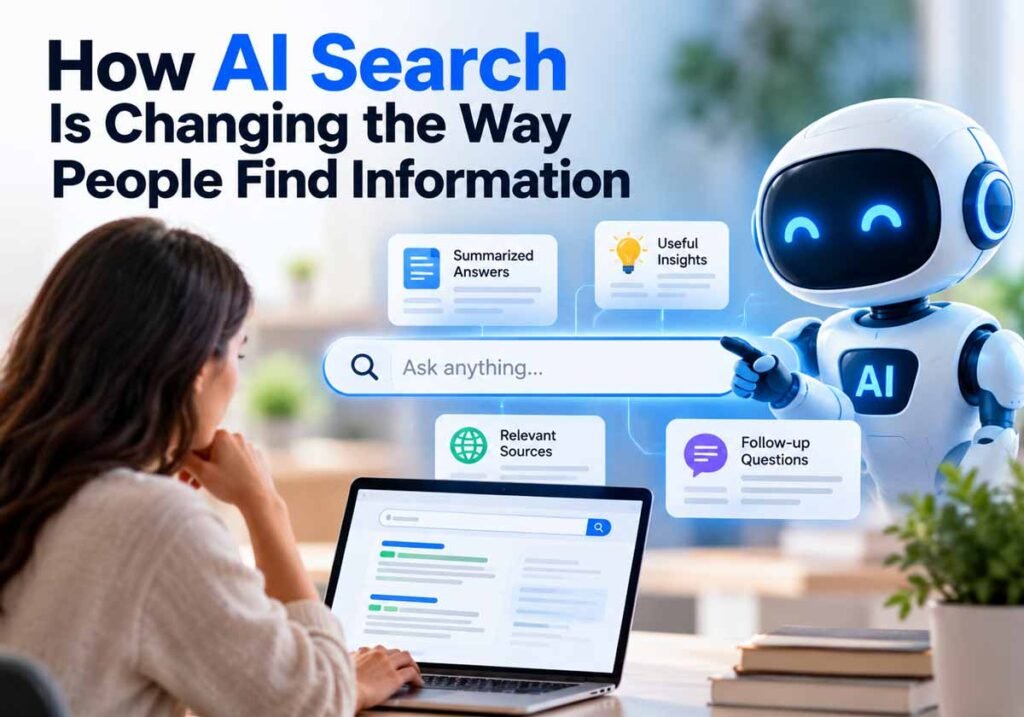
Not long ago, finding something online meant typing a few words into Google, scanning ten blue links, opening three or four tabs, and piecing the answer together yourself. That routine is breaking down. Today you can type a full, messy question, get a written answer in seconds, and keep asking follow-ups as if you were talking to a knowledgeable friend.
That is the core of how AI search is changing the way people find information. The search box isn’t going away, but what sits behind it is changing quickly, and so are people’s habits. If you run a website, write content, or sell something online, this shift affects you more than most algorithm updates ever did.
In this guide, we’ll look at what AI search actually is, how people’s behavior is changing, what it means for traffic, and the practical steps you can take so your content still gets found.
What Is AI Search?
AI search is a way of finding information where an AI system reads your question, gathers information from many sources, and writes a direct answer, instead of just handing you a ranked list of pages.
Traditional search mostly matched the words you typed against words on web pages. AI search tries to understand what you mean. It looks at context, intent and the way the question is phrased, which is why it can handle a long question that no keyword-based engine would have understood.
You have probably already used it without thinking much about it. Common examples include:
- Google AI Overviews and AI Mode, which put a generated summary at the top of the results page.
- ChatGPT, which can browse the web and answer questions in a chat format.
- Perplexity, which answers questions and shows the sources it used.
- Bing with Copilot, which blends classic results with conversational answers.
Under the hood, most of these tools combine a language model with live retrieval. They search for relevant pages, read the key passages, and then write a summary. That is why accuracy and source quality matter so much, and we’ll come back to that later.
AI Search vs Traditional Search
The simplest way to see the difference is to compare what each gives you.
| Traditional search | AI search | |
| What you type | Short keywords | Full questions, with context |
| What you get | A list of links | A written answer, often with sources |
| Your next step | Click, read, compare | Ask a follow-up |
| Who does the synthesis | You | The AI |
Traditional search still matters. Plenty of people still prefer to scan results and judge sources themselves. But the direction of travel is clear: search is moving from “here are some pages” to “here is an answer.”
How People’s Search Behavior Is Changing
The biggest change isn’t the technology. It’s how people now talk to it.
From Keywords to Conversations
A few years ago, someone shopping for a phone typed “best smartphone 2026” and started clicking. Now the same person is more likely to ask: “Which phone has a great camera and a battery that lasts two days, under $500?” That single question holds a budget, two priorities and a clear goal.
People are getting used to describing their situation in full sentences. They explain the problem, add context, and expect the tool to work out the rest.
Follow-Up Questions Are Normal
Search used to be a series of separate, disconnected queries. With AI search, one question leads to the next.
Take a couple planning a trip to Goa. They might begin with “Where should we go in Goa for a quiet holiday?” Then: “What’s the best month to visit?” Then: “How do we get from the airport to North Goa?” Then: “Where should we stay near a quiet beach?” Each answer shapes the next question, and they never start over.
More People Are Getting Answers Without Clicking
Research from London Business School found that after people adopt AI tools, they tend to search less and visit fewer smaller websites. You can read the study summary here. This is often called the zero-click effect: the answer appears on the results page or in the chat, so there is no reason to visit a site.
It’s worth keeping this in perspective. Other analysts point out that most people still use traditional search alongside AI tools, and that heavy AI users are still a minority. So this is a real shift, but not an overnight replacement of Google.
Younger Users Search Everywhere
Many younger users don’t start with a search engine at all. They search on TikTok, Instagram, YouTube and marketplaces, and they ask AI tools for recommendations. “Search” is no longer one place. It’s a habit spread across many apps.
What AI Search Gets Right (and Where It Falls Short)
It’s easy to either hype AI search or dismiss it, so here’s a fair look at both sides.
What it does well
- It saves time on complex questions that used to need several searches.
- It handles long, specific questions that keyword search struggled with.
- It lets you keep exploring a topic without starting over.
- It can summarize reviews, pros and cons, and options in one place.
Where it falls short
- It can state wrong information with total confidence.
- It may pull from weak or biased sources.
- A Wharton study, discussed by eMarketer, found that people who learn through AI search can end up with shallower knowledge of a topic than those who read multiple sources themselves.
- Answers can feel complete when they’ve left out important details.
This matters most for decisions about money, health, law or business. If an AI answer is going to shape a real decision, check it against a trustworthy source first.
Why Quality Content Matters More Than Ever
Some people assume AI search makes websites pointless. The reality is closer to the opposite. AI tools have to get their information from somewhere, and they draw on content that is clear, accurate and genuinely useful.
That means thin, copied or keyword-stuffed pages are the most at risk. Pages that actually answer a question well have a better chance of being used as a source.
Here’s a practical example. Imagine an agricultural website. A generic post titled “Tractor Tips” says very little that any other site doesn’t. A better version walks through how to choose farm equipment by land size, soil type and budget, what routine maintenance costs, and which technology is worth paying for. A mention of a specific product, like a tractor, belongs naturally inside that kind of helpful guide, not stuffed in for its own sake.
The same principle applies to every niche. Write for the person with the problem, not for the algorithm.
Show Real Experience
AI-generated answers are everywhere now, so firsthand experience stands out. A post that says “we tested this plugin on three client sites and here is what broke” is far more valuable than a summary of what everyone else already said. Share results, mistakes, screenshots and numbers whenever you have them.
What This Means for Businesses and Website Owners
If you run a business site, blog or online store, AI search changes what “visible” means. It’s no longer only about ranking number one. It’s also about being the source an AI tool trusts enough to use.
Expect Some Traffic Shifts
For simple, factual questions, such as “what is a meta description,” some visitors will get their answer without clicking. Informational pages with short answers are the most exposed. Pages that go deeper, offer tools or templates, or help people take action are harder for an AI summary to replace.
This is also why your site needs content beyond the basics. If your whole library is simple definitions, you are competing directly with the AI summary at the top of the page.
Think in Journeys, Not Single Keywords
Because people ask follow-up questions, one article rarely covers the whole journey. A better approach is to build a set of connected pages that match each stage of a decision.
Say you sell web hosting services. Someone might first ask what type of hosting a small blog needs, then compare providers, then ask how to migrate, then ask about security. If your site answers all four questions and links them together, you stay useful throughout the conversation.
This is where good internal linking pays off. Our guide on interlinking blog posts in WordPress explains how to connect related pages so both readers and search engines can follow the path.
Protect the Traffic That Converts
Even if total clicks dip, the visitors who do arrive are often further along in their decision. That makes conversion more important than raw volume. If you’re getting fewer but better-qualified visitors, make sure your pages turn them into subscribers or customers. Our breakdown of 25 ways to convert your blog traffic into sales is a good place to start.
How to Optimize Your Content for AI Search
You don’t need to throw out everything you know about SEO. Most of it still applies. You just need to sharpen a few habits.
1. Answer the Question Directly, Then Go Deeper
Open each section with a clear, concise answer, then expand with detail, examples and context. This works for readers and makes your content easier for AI tools to pull from.
For example, if your heading is “How long does it take to rank a new blog?”, the first sentence should give a plain answer, and the rest of the section should explain why it varies.
2. Use Clear Structure
Short paragraphs, descriptive headings, bullet points and tables help people scan and help machines understand your page. Important information shouldn’t be buried in a wall of text.
Make sure every page also has a descriptive title and a useful meta description. If you use Rank Math, its checklist makes this easy, and our roundup of the best WordPress plugins covers other tools worth having.
3. Build Topic Depth, Not Page Count
Instead of publishing ten thin posts for ten near-identical keywords, write one thorough guide that covers a topic properly. A laptop buying guide, for instance, should cover performance, battery life, storage, price and different types of users, all in one place. That single resource answers many related questions at once.
4. Cover the Questions Before, During and After
Think about what a reader wonders before they find you, while they read, and after they finish. Add an FAQ section that answers these directly. It’s one of the simplest ways to match how people now ask questions.
5. Back Up Your Claims
Link to reliable sources, name your author, show when the article was last updated, and explain how you got your information. This builds trust with readers, and AI tools tend to favor content that looks credible and well sourced.
6. Keep Your Business Information Consistent
Your name, address, contact details, and what you offer should match everywhere: your site, your Google Business Profile and your social pages. Local businesses especially benefit from this, because AI tools often name only one or two options when someone asks for a recommendation.
7. Don’t Ignore Traditional SEO
Page speed, mobile-friendliness, clean site structure and good backlinks still matter, because AI tools usually find your content through the same web that search engines crawl. If you’re weighing where to put your budget, our comparison of advertising vs SEO can help.
A Real-World Scenario: Before and After
Picture a small business owner, Priya, who runs an online store selling handmade candles. A few years ago, a customer searched “buy soy candles online,” landed on her homepage, and browsed from there.
Today, the same customer asks an AI tool: “What’s a good gift for someone who loves cozy evenings, under $30?” The AI suggests a few product types and names a couple of shops.
For Priya to be named, her site needs more than a product list. She needs gift guides that actually answer that question, clear product descriptions, real customer reviews, and consistent details across her listings. She also needs content that explains how soy candles differ from paraffin and why that matters. None of this is new SEO. It’s just the old advice, done thoroughly, and it now has a bigger payoff.
The Future of Online Search
Search will likely keep becoming more conversational and more personal. Expect answers that adapt to your location, preferences and past questions, and tools that can complete tasks, not only answer questions.
But websites aren’t going away. AI tools depend on content published by real people and real businesses, and users still want to verify things for themselves when the stakes are high. The sites that win will be the ones that are accurate, original and written for humans first.
If you want to keep an eye on where this is heading, our overview of digital marketing trends tracks the changes that matter, and our list of free AI tools you should know shows what’s worth trying right now. If you’re still building your audience, start with our guide to building a high-traffic blog.
Frequently Asked Questions
What is AI search in simple words?
AI search is a type of search where an AI tool understands your question, collects information from several sources, and gives you a written answer instead of a list of links. Examples include Google AI Overviews, ChatGPT and Perplexity.
How is AI search different from traditional search?
Traditional search matches keywords to pages and shows you a list to click through. AI search interprets the meaning of your question, summarizes information for you, and lets you ask follow-up questions in the same conversation.
Will AI search replace Google?
Probably not in the near future. Most people still use traditional search alongside AI tools, and Google itself is building AI answers into its results. The more realistic outcome is that the two blend together.
Does AI search hurt website traffic?
It can reduce clicks on simple, factual queries, because people get the answer without visiting a site. Pages that offer depth, original experience, tools or clear next steps tend to be less affected.
How can I optimize my content for AI search?
Answer questions directly, use clear headings and short paragraphs, cover topics in depth, add an FAQ, cite reliable sources, show author details and update your content regularly. Keep up the basics of traditional SEO as well.
Can I trust the answers AI search gives me?
Treat them as a starting point, not the final word. AI tools can make mistakes or rely on weak sources. For topics like health, money or law, always confirm with a trusted source.
Do keywords still matter in AI search?
Yes, but they are no longer enough on their own. Understanding the full question behind a keyword, and answering it thoroughly, matters more than repeating a phrase.
Conclusion
AI search is changing how people find information online. Questions are longer, conversations are ongoing, and many answers now appear without a single click. That brings real challenges for websites, but also a clear opportunity for anyone willing to create genuinely helpful content.
The takeaway is simple. Know your audience, answer their questions fully, back up what you say, and organize your content so it’s easy to follow. Do that consistently and you’ll be well placed, whatever the search box looks like next year.
