The question every marketing budget eventually has to answer
At some point, every business owner and marketer faces the same decision: SEO vs paid advertising where should the next marketing dollar go? It is one of the most searched comparisons in digital marketing because the honest answer depends on your timeline, budget, and patience, not on which channel is universally ‘better’.
Here is what the 2026 data actually shows. SEO vs PPC is not really a competition with one winner it is a trade-off between speed and sustainability.
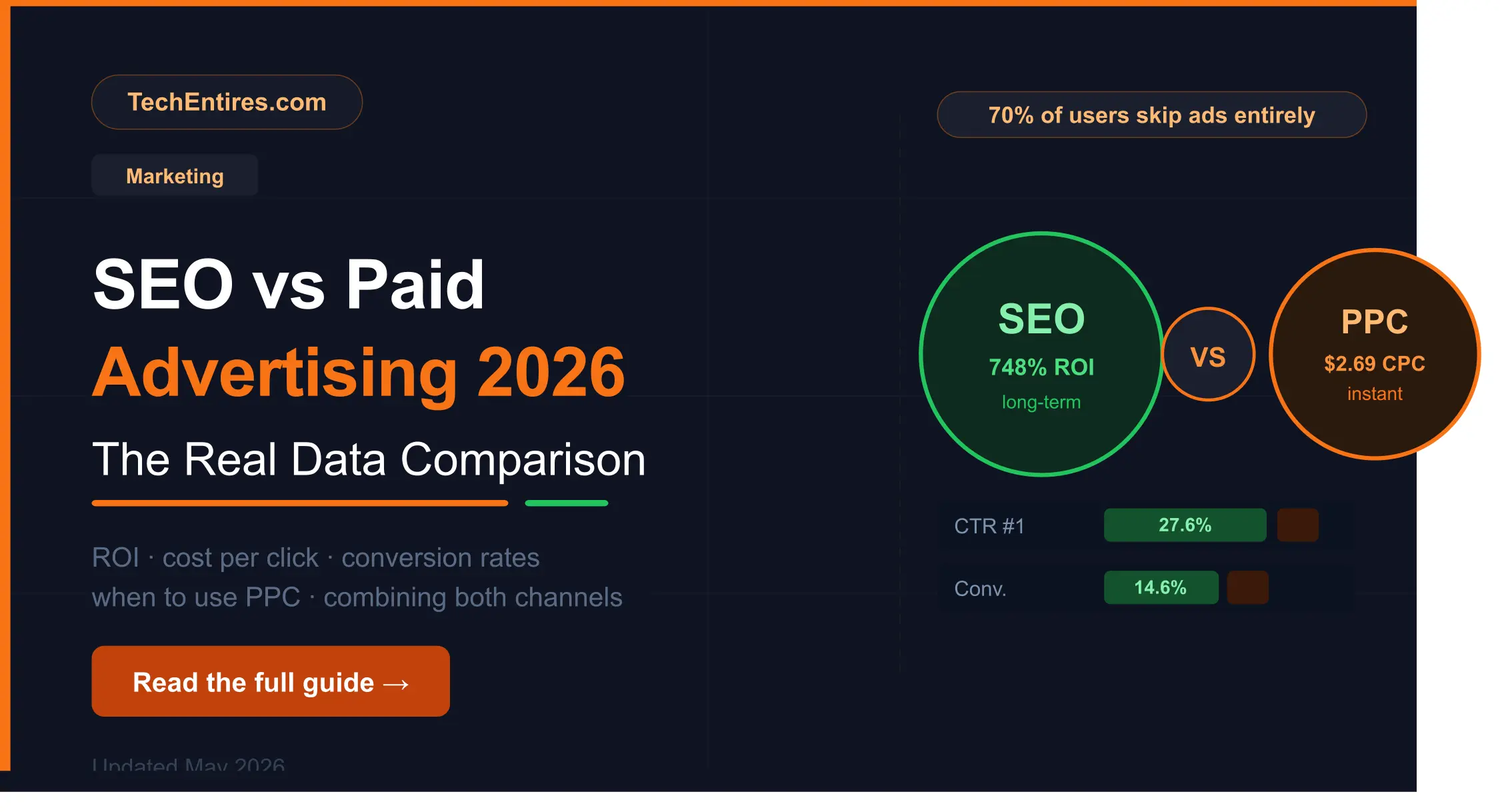
According to a comparative data analysis published by visionary-marketing.co.uk in March 2026, drawing on WordStream Industry Benchmarks (2025) and HubSpot’s State of Marketing report (2025), SEO delivers roughly 748% return on investment over time, while organic search converts visitors 3.9 times better than paid search ads.
But paid advertising still wins decisively on one thing SEO cannot offer: speed.
This guide walks through the real data on advertising vs organic search cost, conversion rates, click-through rates, and return on investment so you can make the decision for your specific business rather than following generic advice that ignores your actual constraints.
Quick context: if you need leads or sales within the next 30 days, this article will help you understand why paid advertising is often the right immediate move while also showing you how to use that same budget to build the long-term SEO foundation that reduces your advertising dependency over time.
SEO vs paid advertising the core mechanical difference
Before comparing performance data, it helps to be precise about what each channel actually is.
- SEO (Search Engine Optimization) the practice of improving your website’s content, structure, and authority so it ranks naturally in organic search results. You do not pay per click. Once a page ranks, it can continue generating organic search traffic for months or years without ongoing spend.
- Paid advertising (PPC / Google Ads) you bid on keywords and pay a cost per click each time someone clicks your ad. Visibility is immediate your ad can appear at the top of search results within hours of launching a campaign. The moment you stop paying, the traffic stops.
This single distinction compounding asset vs ongoing expense is the foundation for almost every other difference in the SEO vs paid advertising comparison.
SEO vs PPC the actual performance data for 2026
Generic claims about ‘SEO being better’ or ‘ads being faster’ are not useful without numbers. Here is the verified comparative data from named industry sources:
| Metric | SEO (Organic) | Paid Advertising (PPC) | Source |
| Click-through rate (CTR), #1 position | 27.6% | 3.2% (top paid ad) | WordStream/HubSpot via visionary-marketing.co.uk, Mar 2026 |
| Conversion rate | 14.6% | 3.75% | Same source |
| Users who actively skip ads | — | 70% | Same source |
| Estimated ROI | ~748% | Lower, ongoing cost | visionary-marketing.co.uk, Mar 2026 |
| Average cost per click (Google Ads, search) | No per-click cost | $2.69 | WordStream via growthscribe.com, Feb 2026 |
| Average cost per lead | $14 | $44 | outpaceseo.com, Mar 2026 |
| Visitor volume | Lower initially | ~2x more visitors | HubSpot via growthscribe.com, Feb 2026 |
Reading this table correctly matters. SEO wins decisively on click-through rate, conversion rate, cost per lead, and long-term ROI. Paid advertising wins decisively on speed and raw visitor volume you can generate traffic immediately, even if a smaller percentage of it converts. Neither channel is objectively superior across every metric. They are optimised for different outcomes.
The trust gap matters more than most marketers admit: 70% of Google users actively skip ads entirely, according to the WordStream/HubSpot benchmark data. This is not a minor detail it means a meaningful majority of searchers structurally avoid the paid results section regardless of how well-targeted or well-written your ad copy is.
This trust gap has widened further with the rise of AI-generated answers see how Google AI Overviews SEO is reshaping organic visibility.
When paid advertising is the right call
Despite SEO’s superior long-term return on investment SEO metrics, there are specific situations where paid search advertising is clearly the better choice and pretending otherwise does a disservice to anyone making real budget decisions.
- You need revenue this month, not in six months. SEO typically takes three to six months minimum to show meaningful ranking movement, even with strong execution. If your business needs leads now, PPC can generate clicks and conversions within hours of launching a campaign.
- You are validating a new product or market. Paid search advertising lets you test which keywords, messaging, and offers actually convert before committing months of content investment to a direction that might not work. Multiple 2026 industry analyses confirm this is one of PPC’s most valuable uses as a fast feedback loop that informs your SEO content strategy.
- You operate in an extremely competitive, established niche. If established competitors have years of domain authority and backlinks built up, ranking organically for your most valuable keywords may take significantly longer than your business can wait. PPC bypasses that authority gap entirely every advertiser bids on equal footing regardless of site age.
- You have seasonal or time-sensitive offers. A flash sale, a limited-time launch, or a seasonal promotion benefits from PPC’s instant visibility far more than from SEO, which is fundamentally unsuited to short-lived campaigns.
Understanding what is domain authority and how it works explains exactly why bypassing that authority gap with PPC can be the smarter short-term move see the full guide.
When SEO is the right call
Is SEO better than paid ads for small business specifically? In most cases, yes primarily because of budget sustainability. Small businesses with limited and finite marketing budgets benefit disproportionately from SEO’s compounding nature compared to PPC’s continuous spend requirement.
- Your business has a long runway. If you can invest in content and technical SEO for six to twelve months before needing maximum traffic, SEO will almost always deliver a better customer acquisition cost over a 12-24 month horizon. The $14 vs $44 cost-per-lead gap compounds significantly at scale.
- Your margins cannot absorb continuous ad spend. PPC is an operating expense that scales with traffic. If your profit margins are thin, a 100% increase in traffic means a 100% increase in advertising cost SEO traffic does not carry that same linear cost relationship.
- You are building a long-term brand asset. Content and rankings built today continue generating organic search traffic for years. A blog post written in 2024 that still ranks in 2026 has effectively paid for itself many times over something no PPC campaign can replicate once the budget runs out.
- Trust and authority matter for your conversion. Higher-consideration purchases services, B2B products, anything requiring research before a decision benefit from the trust signal of appearing organically. The 70% of users who skip ads entirely are exactly the audience SEO captures that PPC cannot reach at all.
Building this kind of lasting organic asset depends heavily on link building for SEO see our complete guide.
SEO and PPC together the strategy most successful businesses actually use
The most data-supported conclusion from 2026 research is not ‘choose one’ it is that SEO and PPC together consistently outperform either channel run in isolation. According to data compiled by Creative Marketing and reported via sixthcitymarketing.com, companies that use both PPC and SEO receive 25% more clicks and 27% more profit than businesses using either approach separately.
The practical reasons this combination works so well:
- PPC funds and informs SEO. Paid campaigns reveal exactly which keywords and ad copy convert before you invest months of content creation into a direction. This is how to combine SEO and paid advertising strategy effectively use PPC data to prioritise your SEO content calendar.
- SERP dominance increases total clicks. Appearing in both the paid ad slot and the organic results for the same query increases your total visible footprint on the search results page, capturing clicks from users with different trust preferences.
- PPC fills the gap while SEO matures. Since SEO takes months to show results, running PPC campaigns for your highest-value keywords during that ramp-up period prevents a revenue gap while your organic rankings build.
- SEO eventually reduces PPC dependency. As organic rankings improve for a keyword, you can reduce or eliminate paid spend on that specific term, reallocating budget to keywords where you still lack organic visibility.
Practical allocation model for small businesses: in the first three to six months, allocate 60-70% of budget to PPC for immediate traffic and keyword validation while building SEO content in parallel. By months six to twelve, as organic rankings begin appearing, shift the allocation toward 50/50.
Beyond twelve months, well-executed SEO often allows you to reduce PPC spend on already-ranking keywords by 40-60%, redirecting that budget to new keyword opportunities or other channels entirely.
Whichever channel brings the traffic, having a system to convert it matters just as much see our guide on how to convert blog traffic into sales .
SEO vs paid ads cost comparison what the numbers mean for your budget
Understanding the cost structure difference is essential for marketing budget allocation decisions. SEO costs are front-loaded content creation, technical optimisation, and link building require upfront investment with no per-click charges.
PPC costs are ongoing and directly tied to traffic volume average cost per click for Google Ads on the search network sits at $2.69, according to WordStream data reported via growthscribe.com in February 2026.
Run the math on a simple example: a business spending $2,000 monthly on PPC at the $2.69 average CPC generates approximately 743 clicks per month.
That same $2,000 invested in SEO content creation, spread over six months as a content investment, builds a set of ranking pages that once they reach page one generate organic search traffic indefinitely without that $2,000 monthly cost repeating. The SEO investment is not free, but it is not recurring in the same way.
This is why outpaceseo.com’s March 2026 analysis found that organic search leads cost an average of $14 compared to $44 for PPC leads a 68% cost advantage that compounds the longer your content continues to rank. The advantage only grows over time as PPC costs continue accruing while SEO content’s marginal cost approaches zero after the initial investment.
Pair your product marketing plan with the latest digital marketing trends in 2026 for a stronger launch
When to use PPC instead of SEO a practical decision framework

Rather than treating this as an either-or decision, use this framework to determine your specific allocation:
| Your situation | Recommended primary channel |
| Need revenue within 30 days | PPC speed is the priority |
| Testing a new product or market | PPC validate before committing to SEO content |
| Limited budget, long runway available | SEO lower cost per lead compounds over time |
| Established competitors dominate organic results | PPC short-term, SEO long-term build |
| High-trust, considered purchase (B2B, services) | SEO captures the 70% who skip ads |
| Seasonal or time-limited offer | PPC SEO timeline does not fit the window |
| Stable, ongoing business with consistent budget | Both 25% more clicks, 27% more profit combined |
This decision should also factor in your existing content foundation. If you already have strong content and internal linking in place see our guide on internal linking strategy your SEO timeline to results is typically shorter than for a brand-new site with no published history.
Frequently Asked Questions
Is SEO better than paid ads for small business?
For most small businesses, yes primarily due to budget sustainability and cost-per-lead efficiency. SEO leads cost an average of $14 compared to $44 for PPC leads, a 68% cost advantage that compounds over time (outpaceseo.com, March 2026). However, small businesses needing immediate revenue or testing a new offer often benefit from starting with PPC before shifting budget toward SEO as rankings build.
SEO vs PPC which has better ROI in 2026?
SEO delivers significantly better long-term ROI according to 2026 data estimated at roughly 748% compared to PPC’s lower ongoing return, based on analysis published by visionary-marketing.co.uk in March 2026 citing WordStream and HubSpot benchmark data. However, PPC ROI is realised faster and is easier to measure directly since ad spend ties precisely to tracked conversions, while SEO ROI builds gradually over months.
How do I combine SEO and paid advertising strategy effectively?
The most effective combination uses PPC to validate keywords, messaging, and audience targeting quickly, then directs SEO content investment toward the keywords and topics proven to convert in paid campaigns.
Run both channels simultaneously during the first six to twelve months, then gradually shift budget away from PPC on keywords where your organic rankings have become established, reallocating that spend to new opportunities.
Companies using both channels together receive 25% more clicks and 27% more profit than using either approach alone (Creative Marketing, via sixthcitymarketing.com).
What is the cost comparison between SEO and paid ads?
SEO costs are front-loaded into content creation, technical optimisation, and link building, with no ongoing per-click charges once content ranks. PPC costs are continuous and directly tied to traffic volume the average cost per click for Google Ads on the search network is $2.69 (WordStream, 2026).
Over a 12 to 24 month period, the total cost of sustained PPC spend typically exceeds the cost of building comparable organic visibility through SEO.
When should I use PPC instead of SEO?
Use PPC instead of SEO when you need revenue within 30 days, are testing a new product or market before committing to content investment, are running a seasonal or time-limited promotion, or are competing in an extremely established niche where organic ranking would take too long given your business timeline.
PPC bypasses the domain authority and content history advantages of established competitors, since every advertiser bids on equal footing.
Do paid ads help SEO rankings?
Paid ads do not directly improve your organic search rankings Google’s algorithm does not factor ad spend into organic ranking decisions.
However, PPC indirectly supports SEO by validating which keywords and messaging convert before content investment, increasing brand visibility and searches for your brand name, and filling the traffic gap while SEO content matures. The relationship is supportive, not causal.
What percentage of users actually click on paid ads vs organic results?
According to WordStream and HubSpot benchmark data reported via visionary-marketing.co.uk in March 2026, the number one organic search result receives a 27.6% click-through rate, compared to just 3.2% for the top paid ad position meaning the top organic result is clicked 8.6 times more often.
Additionally, 70% of Google users actively skip ads entirely, demonstrating a strong structural preference for organic results among the majority of searchers.
