Here’s a number that should make you uncomfortable: 74% of university faculty say their students are using AI to write essays. And 92% of those faculty are worried about it.
That’s not a judgment on students. That’s just the reality of where things stand in 2026 AI is everywhere, universities are scrambling to keep up, and most students are figuring it out alone with no real guidance on what’s actually okay and what isn’t.
This guide gives you that guidance. Not a vague “use AI responsibly” lecture. An actual, stage-by-stage breakdown of where AI genuinely helps with essay writing, exactly what to ask it, and the line you shouldn’t cross plus what happens when you do.
First: The Cheating Question
Let’s get it out of the way properly, because every other guide either dodges it or gives you a non-answer.
Using AI for essay writing is not automatically cheating. Using AI to write your essay is.
That sounds simple but it’s actually an important distinction. If you use ChatGPT to help you brainstorm arguments, that’s not different in kind from talking through ideas with a classmate or a tutor. If you paste the question in, copy the output, and submit it that’s academic misconduct, regardless of whether Turnitin catches it.
The actual line is this: did you do the thinking? Your essay is supposed to demonstrate your understanding, your analysis, your argument. AI can help you develop those things. It cannot do them for you.
And there’s a practical dimension beyond ethics. AI detection tools like Turnitin’s AI detector and GPTZero have improved significantly. AI-written text is statistically more linguistically dense, more evenly structured, and more predictable than human writing and detection tools are specifically trained to find those patterns. The students trying to “humanise” AI output and slip it past detectors are playing a game they’re increasingly losing.
The smarter move is to use AI the right way which also happens to be the way that actually teaches you to write better.
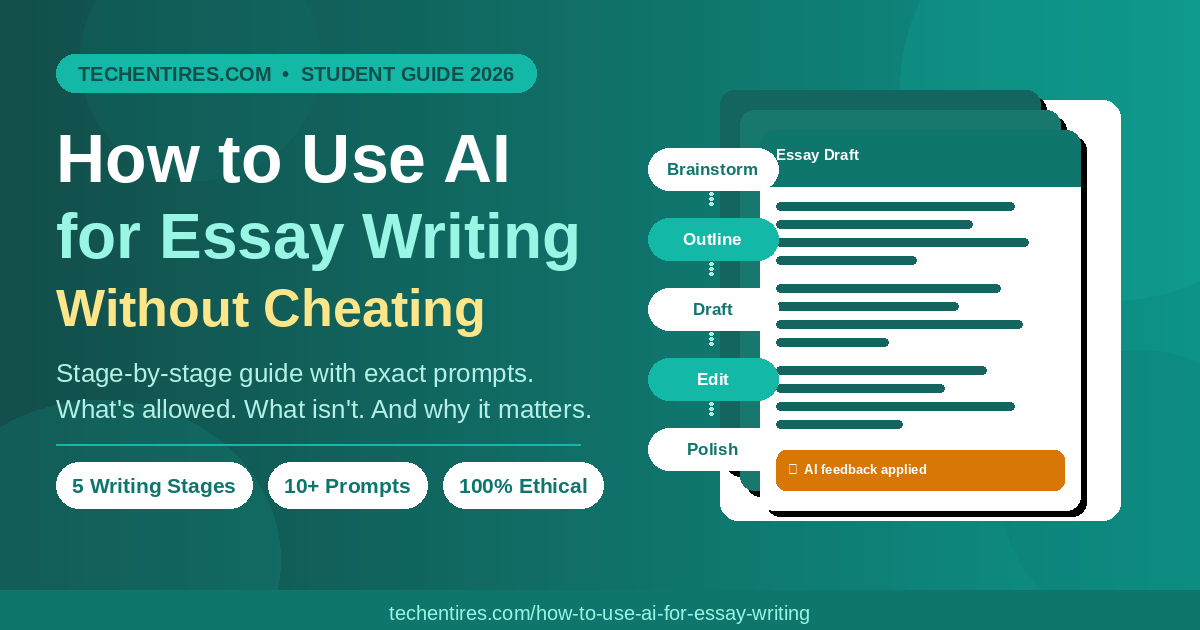
The 5 Stages of Essay Writing and Where AI Fits
Stage 1: Understanding the Question
Before anything else before brainstorming, before research, before a single word you need to understand exactly what the essay question is asking. This is where most students go wrong, and it happens before AI enters the picture at all.
AI can help here in a specific way. Paste the essay question into Claude or ChatGPT and ask it to break down what the question is actually asking. What’s the key instruction word “analyse,” “evaluate,” “compare,” “discuss”? What are the key concepts? What would a strong answer need to demonstrate?
Try this prompt:
“Here is my essay question: [paste question]. Break it down for me. What is it actually asking me to do? What are the key concepts I need to address? What would a weak answer miss that a strong answer would include?”
This is 100% legitimate use of AI. You’re not getting it to write anything you’re using it to clarify your own understanding before you start.
Stage 2: Brainstorming and Developing Your Argument
This is where AI is most useful and most often misused.
Most students either brainstorm nothing and dive straight into writing, or they ask AI to “give me arguments for this essay” and copy what comes back. Both approaches produce mediocre essays.
The right approach: use AI as a thinking partner, not an argument generator.
What that looks like in practice:
Describe your essay topic to ChatGPT and ask it for five different angles you could take. Don’t pick one and run with it read them, think about which one you actually believe or find most defensible, and then push back on it.
Try this prompt:
“My essay question is [question]. Give me five genuinely different positions I could argue. For each one, tell me what the strongest counterargument would be.”
Then pick a position and test it:
“I want to argue [your position]. What are the three strongest objections someone would make to this argument? And what’s the best way to address each one?”
This is what good academic argument-building looks like. AI speeds it up. But you are choosing the position, evaluating the counterarguments, and deciding what actually makes sense. That’s your thinking AI is just accelerating the conversation.
Stage 3: Research and Finding Sources
This is where students get into trouble the fastest, so pay close attention.
What you should use AI for:
Use Perplexity AI in Academic mode to get an overview of your topic and understand what the major debates in the field are. Use it to find directions, not sources. Use SciSpace or Consensus to upload and interrogate actual academic papers ask them what methodology a study used, what its limitations were, whether it supports or contradicts a specific claim.
What you must never do:
Never use a ChatGPT-generated citation in your bibliography. Never. ChatGPT and similar language models hallucinate references they produce author names, journal names, volume numbers, and page numbers that look completely real and don’t exist. Multiple students have been caught submitting bibliographies full of invented papers. It is one of the fastest ways to trigger an academic misconduct investigation.
The safe research workflow:
- Use Perplexity AI (Academic mode) to map the topic and identify key researchers and debates
- Go to Google Scholar yourself and find real papers
- Use SciSpace to help you understand the papers quickly
- Every source in your bibliography verify it exists before you submit
Prompt for topic mapping:
“I’m writing an essay on [topic] for a [subject] course. Give me an overview of the main academic debates on this topic. What do scholars generally agree on? Where is there genuine disagreement? Who are the key researchers I should look at?”
Use the output to guide your Google Scholar search. Don’t cite it.
Stage 4: Writing the Essay
Here is the rule, stated clearly: write the essay yourself.
The first draft comes from you. Not AI. You.
This is not just about academic integrity it’s about what actually builds your writing skills. Every essay you write yourself makes you a better writer. Every essay AI writes for you makes you more dependent on AI and less capable without it.
What you can do at this stage:
Use AI to check your outline before you write. Once you have a plan introduction, argument structure, evidence, conclusion paste it into Claude and ask: “Does the logic flow? Does each section actually support the thesis? What’s missing?”
Try this prompt:
“Here is my essay outline: [paste outline]. I’m arguing [thesis]. Does the argument flow logically from the introduction to the conclusion? Where is the structure weakest? What would a marker notice as gaps?”
Fix the structure issues before you start writing, not after you’ve spent three hours going in the wrong direction.
After you’ve written each section, ask for specific feedback. Not “is this good?” that’s useless. Ask targeted questions.
Try these prompts:
“Read this paragraph. Is it making an argument or just describing? What would need to change to make it more analytical?”
“Does this paragraph prove the point I said it would in my topic sentence? If not, what’s going wrong?”
“Is the transition between this paragraph and the next one clear? Does the logic connect?”
This kind of targeted AI feedback is more useful than a tutor who reads your whole essay once and says “good structure.” And it’s completely legitimate you wrote the content, you’re asking for feedback on your own work.
Stage 5: Editing and Polishing
This is where tools like Grammarly and Claude shine and where the risk of crossing into misconduct is lowest because the ideas and arguments are already entirely yours.
Grammar and clarity: Grammarly catches errors in real time as you write. Run your final draft through it before submission. Most universities provide Grammarly Premium free check with your IT department.
Sentence-level feedback: Paste specific sentences or paragraphs into Claude and ask it to identify anything unclear, awkward, or logically shaky. Then rewrite it yourself in your own words. Don’t paste Claude’s rewrite into your essay use it to understand what’s wrong, then fix it yourself.
Try this prompt:
“Read this paragraph. Point out any sentences that are unclear, any claims that aren’t supported, and any phrasing that sounds awkward. Don’t rewrite it just tell me what’s wrong so I can fix it myself.”
QuillBot is useful for rephrasing individual sentences that feel clunky. Use it sparingly on one or two sentences, not entire paragraphs. If you’re rephrasing whole paragraphs in QuillBot, you’re already using it more like a ghostwriter than an editor.
One final check: Read your essay out loud. If it doesn’t sound like you if it’s more formal, more structured, or more polished than your natural voice that’s a flag worth paying attention to. Not because a detector will catch it, but because you want your work to actually represent your thinking.
What About AI Detection?
Let’s be direct about this. Turnitin’s AI detector, GPTZero, and similar tools are not perfect. They produce false positives. Students who write in a very structured, formal style sometimes get flagged even when they wrote everything themselves.
But here’s the practical reality: if you wrote your essay yourself, using AI only for brainstorming, research direction, and editing feedback, you have nothing to worry about. Your voice will be in the text. Your argument structure will reflect your thinking. The essay will read like a person, because a person wrote it.
The students sweating AI detection are the ones who used AI to write most of the content. Which means the real solution to the detection problem is also the ethical solution: do the writing yourself.
If your institution requires disclosure of AI use, disclose it. A simple methodology note works: “I used ChatGPT to help brainstorm possible arguments for this essay. All research, writing, and analysis were performed independently.” That kind of transparency actually builds your credibility rather than undermining it.
Before you write, you need strong sources. Here’s exactly how to find your sources with AI before you start writing.”
The AI Essay Writing Mistakes That Are Failing Students
Generating an essay and lightly editing it. Detectors are getting better at finding this. More importantly, it produces generic arguments and bland writing. Essays written this way rarely score well.
Asking AI “what should I argue?” instead of developing your own position first. This is backwards. Form a rough view first, then use AI to stress-test it. When AI decides your argument, you end up defending a position you don’t really understand.
Trusting AI citations. Covered above. Non-negotiable verify every single source yourself.
Using AI feedback as a substitute for actually understanding your essay’s weaknesses. If Claude tells you your introduction is weak, don’t just ask Claude to fix it. Understand why it’s weak. That understanding is what you’re actually at university to develop.
Starting the night before and expecting AI to save you. AI compresses time it doesn’t create it. An essay you haven’t thought about for more than 12 hours will produce thin arguments even with AI assistance. The best AI-assisted essays come from students who have been sitting with the ideas for a few days before they start writing.
Your AI Essay Writing Toolkit
These are the specific tools for each part of the process:
Brainstorming and argument development: ChatGPT or Claude both handle open-ended discussion well.
Research direction: Perplexity AI (Academic mode) real citations, no hallucinations.
Reading academic papers: SciSpace or Consensus plain English explanations of dense research.
Outline and structure feedback: Claude particularly good at spotting logical gaps in argument structure.
Grammar and clarity: Grammarly always on, works inside Google Docs and your browser.
Sentence-level editing: Claude or QuillBot use for specific problem sentences, not whole paragraphs.
What you don’t need: Any tool that promises to write the essay for you, help you bypass AI detection, or “humanise” AI content. Those are tools for cheating, not tools for writing.
The Bottom Line
AI makes essay writing faster. It doesn’t make it easier in the way that matters the thinking, the argument construction, the actual understanding that good essays are supposed to demonstrate.
The students using AI well in 2026 are doing more analytical work, not less. They’re stress-testing their arguments before they commit to them. They’re getting feedback on their structure before they’ve wasted hours going in the wrong direction. They’re fixing their own sentences instead of submitting things they don’t understand.
That’s a legitimate, powerful use of these tools and it produces better essays than either ignoring AI entirely or outsourcing the writing to it.
The question isn’t “can I use AI for this essay?” The question is “am I still doing the thinking?”
If the answer is yes, you’re fine.
For the complete student AI toolkit: AI for Students: The Complete Guide (2026)
For AI study techniques beyond exam prep: How to Use AI for Studying: 10 Smart Ways
For the best tools in detail: 15 Best AI Tools for Students in 2026
ChatGPT on Homeword: How to Use ChatGPT for Homework Without Cheating
The complete AI exam prep guide: How to Use AI for Exam Prep
For the full AI student toolkit: AI for Students: The Complete Guide (2026)
