Most students study wrong. Not because they’re lazy because the method they were taught produces the feeling of learning without the actual thing.
Rereading notes feels productive. It isn’t. Your brain recognises the words and mistakes familiarity for knowledge. Then the exam asks you to retrieve that knowledge under pressure and nothing comes. That’s not a memory problem. That’s a study method problem.
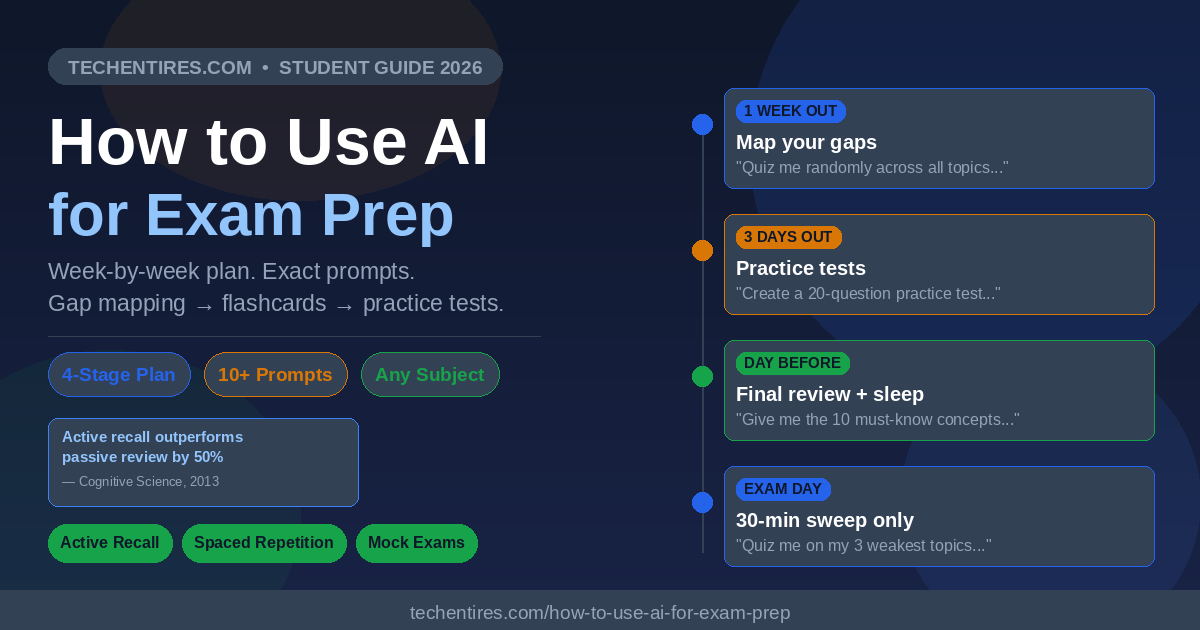
AI doesn’t fix bad study habits automatically. But when used correctly, it replaces passive review with active recall the method that cognitive science consistently ranks as the highest-impact study strategy available. Students using active recall methods score an average of 50% higher on long-term retention tests than those using passive review.
This guide breaks exam prep into a timeline what to do the week before, three days before, the day before, and the morning of. Every section includes the exact tools and prompts that make it work.
Why Most Exam Prep Fails (And What AI Actually Fixes)
Before getting into the how, understand the why.
There are three reasons most exam prep fails:
You don’t know what you don’t know. Students study everything equally because they have no accurate map of where their gaps actually are. They spend two hours on material they already understand and thirty minutes on the topic that’s going to cost them marks.
You’re recognising, not recalling. Recognition happens when you see something and it seems familiar. Recall happens when you retrieve it from nothing. Exams test recall. Rereading, highlighting, and watching lecture recordings build recognition. Active testing forcing yourself to produce answers from memory builds recall. Most students do almost none of the latter.
You start too late. Cramming the night before produces short-term retention that degrades rapidly. The brain consolidates memory during sleep, across multiple review sessions, over time. One ten-hour session the night before is dramatically less effective than five two-hour sessions spread across a week.
AI addresses all three if you use it in the right order at the right times.
The Week Before the Exam
This is where the real work happens. If you start here, you have time to find your gaps and actually fix them.
Step 1: Map Your Knowledge Gaps First
Before you touch a flashcard or open a revision guide, do this.
Open ChatGPT or Claude. Tell it every topic your exam covers the full syllabus if you have it. Then ask it to quiz you across all of them, randomly, one question at a time.
Use this prompt:
“My exam covers these topics: [list every topic]. Quiz me randomly across all of them one question at a time. Don’t give me the answer until I respond. After 20 questions, show me which topics I struggled with most.”
Do this for 20–30 minutes. Note every question you hesitated on, got wrong, or guessed. That list is your actual revision priority not the topics you find interesting, not the ones you feel confident about. The ones you got wrong.
This single step saves hours of wasted revision time. Most students discover their gaps are in completely different places than they assumed.
Step 2: Generate Flashcards from Your Own Notes
Take your lecture notes and materials for the weak topics you identified and paste them into ChatGPT, Claude, or Knowt. Ask for flashcards.
Use this prompt:
“Here are my notes on [topic]: [paste notes]. Create 25 flashcards. Each card should have one clear question on the front and a concise, specific answer on the back. Focus on definitions, processes, key figures, and anything I’d need to recall under exam pressure.”
Then import those cards into Anki or Quizlet. This is non-negotiable don’t just read the cards back. Use a spaced repetition system that schedules your reviews based on what you know and what you don’t. The algorithm does the timing so you don’t have to.
Review your new decks every day for the rest of the week. Twenty minutes per session. That’s it.
Step 3: Build a Realistic Study Plan
Students who plan their revision outperform those who don’t not because planning is magic, but because it removes the daily decision of what to study next and ensures weak topics get proportionally more time.
Use this prompt:
“My exam is on [date]. It covers: [topics]. Based on my quiz results, my weakest areas are: [list]. I can study [X] hours per day. Build me a day-by-day revision plan from today until the exam. Prioritise my weak topics. Include daily goals, not just subjects.”
The plan won’t be perfect. Adjust it as you go. The point is having a structure that keeps you moving forward instead of defaulting to the material you already know.
Three Days Before
By now you should have reviewed your flashcards daily and have a clearer picture of where you’re actually strong and where you’re still shaky. This is when you shift from building knowledge to testing it under pressure.
Step 4: Run Full Practice Tests
Generate timed practice tests that match your actual exam format. Don’t do this with open notes. Do it under real conditions timed, no help, closed book.
For multiple choice exams:
“Create a 20-question multiple choice practice test on [topic]. Four options per question, one correct answer. Make the wrong options plausible, not obviously wrong. Include an answer key with brief explanations at the end.”
For essay or short answer exams:
“Generate 5 short answer questions and 2 essay questions on [topic] at [university level]. Include a mark scheme for each showing what a high-scoring answer would contain.”
Do the test. Mark it yourself using the answer key or mark scheme. Every question you got wrong goes back on your gap list.
Step 5: Use NotebookLM to Interrogate Your Own Materials
If you haven’t uploaded your notes to NotebookLM yet, do it now. Upload everything lecture slides, your own notes, any readings you have on the topic.
Then use it to probe your understanding, not just your memory.
Try these prompts inside NotebookLM:
“Based only on my uploaded notes, explain the relationship between [concept A] and [concept B].”
“What are the three most likely exam questions based on what my notes emphasise? What would a complete answer to each look like?”
“Quiz me on [specific topic] using only my uploaded materials. Start easy and get harder.”
This is different from ChatGPT because it’s working from your exact course materials not general knowledge. The questions it generates will be relevant to what your professor actually taught, not just the topic in the abstract.
Step 6: Simulate the Exam Experience
This is the most uncomfortable step and the most valuable one.
Set a timer. No notes. No AI. Answer practice questions in writing typed or handwritten exactly as you would in the real exam. The pressure is the point. Your brain needs to practise retrieving information under time constraint, not just when you can sit back and think.
After the session, paste your answers into Claude and ask for specific feedback:
Use this prompt:
“Here are my answers to these exam questions: [paste answers]. Here are the questions: [paste questions]. Score each answer out of 10 and tell me specifically what I missed, what was vague, and what was good. Don’t rewrite my answers just tell me what’s wrong.”
Read the feedback. Don’t ask Claude to fix the answers. Go back and rewrite them yourself based on what you now understand was missing.
The Day Before
This is not the time to learn new material. If you don’t know it by now, six panicked hours the night before won’t fix that and trying to force it will crowd out what you do know.
What to Do
Final flashcard review. One pass through all your Anki or Quizlet cards. Flag anything that still feels shaky.
NotebookLM final pass. Ask it to surface the concepts you’ve starred or flagged as uncertain. Ask it three or four specific questions about topics you’re still not confident on.
Use this prompt for a final sweep:
“Based on my uploaded notes, what are the 10 most important concepts I absolutely need to know for tomorrow’s exam? Give me a one-sentence summary of each.”
Read those 10 summaries. Close the laptop.
What not to do. Don’t start a new topic. Don’t re-read entire chapters. Don’t generate a hundred new flashcards at 11pm. Don’t ask AI to write you a summary of the entire course. None of that consolidates in one night.
Sleep is not optional. Memory consolidation happens during sleep. The research on this is unambiguous students who sleep adequately before an exam consistently outperform students who cram through the night, even when the cramming students objectively covered more material.
The Morning Of
Keep it short. Thirty minutes maximum.
A light review of your weakest topics only. Not the whole course. The three or four specific things that still feel uncertain.
One final prompt:
“I have an exam in two hours on [subject]. My weakest areas are [list]. Give me a rapid-fire five-question quiz on just those topics. One question at a time.”
Answer the questions. Check the answers. Then stop. You’ve done the work. More cramming in the final two hours produces anxiety, not retention.
The AI Exam Prep Stack
The tools that do the actual work, matched to what they’re best at:
ChatGPT or Claude gap mapping quizzes, flashcard generation, practice test creation, answer feedback. Use whichever you’re more comfortable with. Both handle these tasks well.
NotebookLM chatting with your own uploaded materials. This is the tool most students haven’t discovered yet. Once you upload your notes and realise it can quiz you specifically on what your professor taught, everything else feels like a workaround.
Anki or Quizlet spaced repetition scheduling. Generate the cards with AI, review them here. Anki is free and more customisable. Quizlet has a cleaner interface and works well for most subjects.
Knowt worth mentioning separately because it generates flashcards directly from uploaded PDFs and lecture slides without any prompting needed. For students who find copy-pasting into ChatGPT tedious, Knowt removes a step.
Otter.ai if you recorded your lectures, use it now. Search by keyword to find the exact moment your professor explained a concept you’re still unclear on. Faster than rewatching the whole recording.
The Mistakes That Waste Your Prep Time
Using AI to summarise and calling it revision. Reading a summary is passive. It creates familiarity, not recall. Every session should involve you being tested not you reading output.
Generating flashcards you never actually review. Making the cards feels like studying. Reviewing them with a spaced repetition schedule is what builds memory. One without the other is wasted effort.
Asking AI for answers instead of asking it to quiz you. There’s a fundamental difference between “explain osmosis to me” and “quiz me on osmosis without giving me the answer first.” One builds understanding. The other builds dependence.
Using AI to replace sleep and time. AI compresses study time. It doesn’t eliminate the need for it. Starting serious exam prep the night before and expecting AI to close a semester-long gap is not a strategy it’s a wish.
Studying everything equally. Your gap map from Step 1 tells you where to focus. Trust it. The topics you already know don’t need more of your time.
The Bottom Line
Active recall, spaced repetition, and practice testing are the three most effective study strategies cognitive science has identified. AI makes all three faster, more targeted, and available at any hour without needing a study group or a tutor.
The students using AI well for exam prep aren’t studying less. They’re studying smarter finding gaps earlier, drilling weak spots harder, and testing themselves under pressure before the real thing arrives.
Start a week out. Map your gaps first. Test yourself relentlessly. Sleep.
That’s the system.
For the complete student AI toolkit: AI for Students: The Complete Guide (2026)
For AI study techniques beyond exam prep: How to Use AI for Studying: 10 Smart Ways
For the best tools in detail: 15 Best AI Tools for Students in 2026
ChatGPT on Homework: How to Use ChatGPT for Homework Without Cheating
The complete AI exam prep guide: How to Use AI for Exam Prep
Worried about academic integrity? Is Using AI Cheating? The Honest Answer
