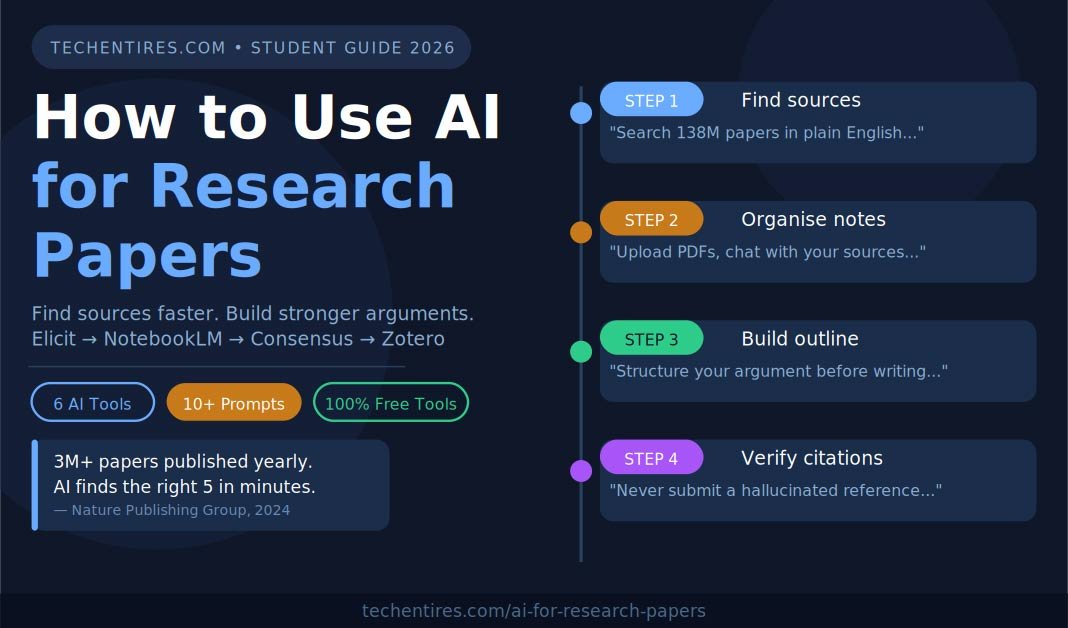
Using AI for research papers has changed how students work, but most guides skip the part about staying academically honest. This one doesn’t. You weren’t sure were relevant. Now it means knowing which AI tools to use and how to use them without crossing the academic integrity line.
That second part is what most guides skip. They list tools without telling you what’s acceptable and what gets you flagged for academic dishonesty. This guide covers both how to use AI for research papers as a student in 2026, step by step, with the ethical boundaries clearly marked at every stage.
Why AI Has Changed Research Papers Completely
The numbers explain the shift. Over 3 million new academic papers are published every year. No student can manually sift through thousands of studies to find the five that matter for their topic. AI tools have made that process finding, filtering, and summarising relevant research dramatically faster without replacing the thinking and writing that is yours to do.
The students who do this well in 2026 are not the ones who use AI to write their papers, they’re the ones who’ve already learned how to use AI for studying the right way. They are the ones who use AI to find better sources, build stronger arguments, and catch gaps in their research faster than their peers who still do everything manually.
Where AI Helps and Where It Doesn’t
Before getting into specific tools, understand what AI is genuinely useful for in a research paper and where it fails you.
AI is useful for: Finding relevant papers you wouldn’t have found manually. Summarising long studies so you can decide if they’re worth reading in full. Identifying gaps in existing research. Structuring your outline. Checking grammar and clarity in your own writing.
AI is not reliable for: Writing your arguments it doesn’t know your course material, your professor’s expectations, or your specific thesis. Generating citations AI hallucinated citations are one of the most common academic integrity violations right now. Drawing conclusions from data it hasn’t actually analysed. Replacing your own reading and critical thinking.
Use it where it’s strong. Don’t use it where it fails. That’s the honest framework.
Step 1: Find Your Sources Using AI for Research Papers”
This is where AI saves the most time and carries the least risk. Finding relevant academic literature is mechanical work AI does it better and faster than manual database searching.
Elicit
Elicit searches over 138 million academic papers and returns results based on the meaning of your question not just keyword matching. Type your research question in plain English and it surfaces relevant studies, extracts key findings, and organises them into a table you can scan in minutes.
What makes it genuinely useful: you can ask it to extract specific information from each paper like methodology, sample size, or conclusions and it builds a comparison table automatically. That table becomes the foundation of your literature review.
Free tier is sufficient for most undergraduate research papers. Go to elicit.com to get started free account, no credit card needed.”
Consensus
Consensus is built specifically for students and researchers who need evidence-backed answers. Type a question “Does spaced repetition improve long-term memory retention?” and it searches peer-reviewed papers and tells you what the scientific consensus actually is, with citations.
The Consensus Meter is its standout feature. It shows at a glance whether the research supports, opposes, or is divided on a topic. Useful for framing your argument and understanding where genuine debate exists in your field.
Free with limited searches. Consensus.app.
Semantic Scholar
Free, comprehensive, and backed by the Allen Institute for AI. Searches over 200 million academic papers with AI-powered relevance ranking. The TLDR feature gives you a one-sentence AI summary of any paper so you can quickly decide whether it’s worth reading in full.
Use this alongside Elicit Semantic Scholar is stronger for broad discovery, Elicit is stronger for systematic extraction. Together they cover the full scope of a literature search. Semanticscholar.org.
Perplexity AI
Perplexity is useful at the very start of research when you know your topic but don’t know the landscape yet. Ask it a broad question about your topic and it gives you a structured overview with inline citations. It’s not a replacement for academic databases but it’s excellent for scoping a new topic before you dive into the academic literature.
Always verify every source Perplexity cites before using it. Check that the paper exists, is from a credible journal, and says what Perplexity claims it says. This takes two minutes per source and protects you from hallucinated citations.
Step 2: Organise and Summarise What You Find
Found ten papers that look relevant? Now you need to read and understand them. AI tools can help you process papers faster without replacing your actual reading.
NotebookLM
Google’s NotebookLM is one of the most practically useful AI tools for students writing research papers right now. Upload your PDFs up to 50 sources and it creates an AI that has read all of them and can answer your questions about them.
Ask it: “What do these sources say about the relationship between sleep deprivation and academic performance?” It synthesises across all your uploaded papers and gives you a referenced answer, telling you which specific paper each point comes from.
This is not the same as asking ChatGPT a question. NotebookLM is grounded in your actual documents it cannot hallucinate sources because it only draws from what you uploaded. Free at notebooklm.google.com.
SciSpace
SciSpace lets you upload any research paper and chat with it directly. Ask it to explain a complicated methodology section, summarise the findings in plain English, or identify the limitations the authors acknowledge. Useful when you’re reading outside your subject area or when statistical methods need unpacking.
The Copilot feature works while you’re reading papers in your browser hover over any sentence and it gives you an instant explanation. Free tier available at typeset.io.
Step 3: Build Your Outline With AI Assistance
Once you know your sources and understand the landscape of your topic, use AI to help you build a solid structure before you start writing.
Open ChatGPT or Claude. Give it your thesis statement, your assignment brief, and a list of the main points you’ve gathered from your research. Not sure how to prompt ChatGPT properly? Our guide on how to use ChatGPT for homework covers exactly that. Ask it to suggest an outline structure.
What to ask: “I’m writing a 2,500-word research paper arguing that social media use negatively affects adolescent sleep quality. My main sources cover sleep deprivation effects, screen time studies, and blue light research. Suggest a logical structure for this paper.”
What you get back is a starting point not a final structure. Read it, move sections around, add what’s missing, remove what doesn’t fit. The AI gives you a scaffold. You decide what the paper actually argues.
What not to do: Don’t give it your sources and ask it to write sections for you. That’s the line. Using AI to structure your thinking is research assistance. Submitting AI-written paragraphs as your own work is academic dishonesty and detection tools in 2026 are significantly better at catching it than they were two years ago.
Step 4: Write the Paper Yourself
This step has no AI shortcuts that are academically acceptable. The writing is yours. If you need help with the actual writing process, read our guide on how to use AI for essay writing without cheating.
But AI can help you write better without writing for you.
Use Hemingway Editor to check readability. Paste in sections you’ve written and it flags sentences that are too long, passive voice, and unnecessary complexity. It doesn’t rewrite anything it shows you what to fix. Free at hemingwayapp.com.
Use Grammarly or LanguageTool for grammar and clarity checks. These are accepted at virtually every university they’re proofreading tools, not content generators. Most universities explicitly permit grammar checkers.
Use ChatGPT to explain concepts you don’t fully understand. If you’re citing a study that uses a statistical method you’re unfamiliar with ask ChatGPT to explain it in plain English. Understanding your sources better makes your own writing more accurate. That’s legitimate.
Step 5: Handle Citations Properly
This is the highest-risk area for AI use in research papers. Hallucinated citations AI-generated references to papers that don’t actually exist are one of the most common reasons students face academic integrity investigations in 2026.
The rule is simple: never use AI to generate your reference list.
Use your university library’s database, Google Scholar, or Semantic Scholar to find real papers. Use a proper citation manager Zotero (free) or Mendeley (free) to format them correctly. Both tools pull citation data directly from academic databases and format it in APA, MLA, Chicago, or whatever style your course requires.
If you want AI involvement in citations use Elicit or Consensus, which cite the real papers they’re drawing from with verifiable DOIs. Check every citation they surface exists before including it. Use Google Scholar or your university library database to verify every citation.
Step 6: Check Your Work Before Submitting
Before you submit, run two checks.
Check 1 Academic integrity scan Many universities use Turnitin or similar tools. If yours does, you already know what they check. The newer versions also flag AI-generated text which is why submitting AI-written content is riskier in 2026 than it was in 2023. If you’ve written your paper yourself and used AI only for research assistance and outline building, this is not a concern.
Check 2 Source verification Go through every citation in your paper. Confirm the paper exists. Confirm it says what you claim it says. Confirm the publication details are accurate. This takes 20 minutes and protects you from submitting a paper with fabricated references even if you generated them accidentally by trusting an AI summary without checking.
The Ethical Line Where It Is in 2026
Universities have updated their AI policies significantly over the past two years. Most now fall into one of three positions:
Permitted: Using AI for research discovery, summarisation of sources, grammar checking, and structural planning with disclosure where required.
Restricted: Using AI to draft sections of the paper that you then edit and submit as your own, without disclosure.
Prohibited: Submitting AI-generated text as your own work without any disclosure or attribution.
Check your specific university’s policy before you start. Still unsure where the line is? We covered this in detail in is using AI cheating the honest answer for students.
When in doubt, disclose a brief note in your methodology section or acknowledgements saying you used Elicit for literature discovery and Grammarly for proofreading is transparent and increasingly expected.
The students who get into trouble are the ones who use AI to write content they couldn’t write themselves and submit it as original work. The students who benefit are the ones who use AI to research more thoroughly and write more clearly than they could otherwise.
These are the tools covered in this guide. For a complete list covering every subject and study need, see our best AI tools for students guide.”
Best Free AI Tools for Research Papers Quick Reference
These are the best free tools for using AI for research papers in 2026.
| Tool | Best For | Free? |
| Elicit | Finding and extracting from academic papers | ✅ Free tier |
| Consensus | Evidence-backed answers with citations | ✅ Free tier |
| Semantic Scholar | Broad paper discovery | ✅ Completely free |
| NotebookLM | Chatting with your uploaded sources | ✅ Completely free |
| Perplexity | Topic scoping and overview | ✅ Free tier |
| SciSpace | Reading and understanding papers | ✅ Free tier |
| Zotero | Citation management | ✅ Completely free |
| Hemingway Editor | Writing clarity | ✅ Completely free |
| ChatGPT | Outline building and concept explanation | ✅ Free tier |
Final Thought
AI has made research papers faster to research and easier to structure. It has not made them easier to write well that still requires your thinking, your argument, and your understanding of the material.
The students who use these tools correctly will do better work in less time. The ones who try to shortcut the actual writing will get caught because the tools universities use to detect AI-generated content have kept pace with the tools that generate it.
AI for research papers works best when you use it for research, not writing. That combination is genuinely unbeatable. For everything else AI can do for your studies, start with our complete AI for students guide.
