DeepSeek went from a name almost nobody outside AI research recognized to a company that briefly wiped hundreds of billions off US tech stocks in a single week.
That happened in January 2025. A lot has changed since then, and most explainers still floating around online haven’t caught up, they skip the company’s actual ownership, miss the current model lineup entirely, and repeat vague marketing claims instead of real facts, some even getting basic details like who actually owns the company wrong.
This guide covers what DeepSeek actually is, who really owns it, how its pricing works in 2026, and an honest comparison against ChatGPT and Claude, not a one-sided “why DeepSeek is better” pitch.
What Is DeepSeek AI, Really?
DeepSeek is a Chinese artificial intelligence research lab that builds large language models, the same category of technology behind ChatGPT and Claude.
It offers a free web chat interface, a developer API, and open-weight models that anyone can download and run on their own hardware, which is a meaningfully different approach than the fully closed models most Western competitors ship.
What actually sets DeepSeek apart isn’t a vague “smarter AI” claim, it’s the combination of a Mixture-of-Experts (MoE) architecture and genuinely aggressive pricing. MoE models activate only a fraction of their total parameters for any given request, which cuts computing cost dramatically compared to a traditional “dense” model of similar size.
That efficiency is a big part of why DeepSeek can charge a fraction of what Western frontier labs charge for comparable capability, and it’s a structural, architectural reason rather than simply a business decision to undercut competitors on price.
Who Owns DeepSeek?
DeepSeek was founded in 2023 by Liang Wenfeng, a Zhejiang University graduate who got his start in quantitative trading. Wenfeng had already co-founded High-Flyer, a Chinese hedge fund that uses AI models to inform its trading decisions, back in 2015, later formalized as High-Flyer Capital Management in 2019.
DeepSeek began as an internal AI research lab inside High-Flyer, separate from the fund’s trading business, before spinning off into its own company, still backed by High-Flyer as an investor.
That hedge-fund origin explains something people often find surprising: DeepSeek wasn’t built by a typical Silicon-Valley-style AI startup chasing venture funding.
It grew out of a firm that was already running large-scale computing infrastructure for financial modeling, which gave it a head start on the infrastructure side before it ever released a public chatbot, and it likely explains part of why the company was able to move so quickly once it turned its focus toward large language models specifically.
The company is based in Hangzhou, China, and has not publicly disclosed its total funding or valuation. DeepSeek has also committed to open-sourcing its models, releasing the model weights publicly rather than keeping them entirely proprietary, which stands in contrast to the more closed approach several Western labs take with their flagship models, and it’s part of why DeepSeek’s models are widely available through third-party API providers, not just DeepSeek’s own platform.
How DeepSeek Became Famous: The January 2025 Shock
DeepSeek existed quietly for over a year before most of the world had heard of it. That changed on January 10, 2025, when the company released DeepSeek-R1, a reasoning-focused model that shows its own step-by-step thinking process before answering. Within weeks, DeepSeek’s chatbot app rocketed to the top of the Apple App Store in the US, outranking ChatGPT, and climbed similarly high on Google Play.
What actually triggered the stock market reaction wasn’t just the model’s capability, it was the claimed training cost. DeepSeek reported training R1 for roughly $5.58 million using around 2,000 Nvidia H800 GPUs (a less powerful chip than the H100, a result of US export restrictions on advanced chips to China) over about 55 days.
That figure stood in stark contrast to the hundreds of millions US labs were reportedly spending on comparable training runs, and it raised a genuinely uncomfortable question for investors: if a capable model could be trained this cheaply, did the AI industry’s assumptions about compute spending, and the chip demand behind it, actually hold up? US tech stocks, including major chipmakers, dropped sharply on January 27, 2025 as that question sank in, with the broader selloff affecting hardware and infrastructure companies well beyond the AI labs themselves.
It’s worth noting the training-cost figure describes the final training run specifically, not DeepSeek’s total research and development spending, a distinction that got lost in a lot of the initial coverage.
That nuance doesn’t erase the significance of the moment, but it’s a more accurate way to understand what actually happened than the simplified “trained for $5 million” headline that circulated widely at the time.
DeepSeek’s Models Explained
DeepSeek-V3 and the original R1
DeepSeek-V3 was the general-purpose flagship model that preceded the R1 breakthrough, a large Mixture-of-Experts model built for broad tasks: writing, coding, and general reasoning.
DeepSeek-R1 built on that foundation specifically for reasoning-heavy tasks, adding visible chain-of-thought output so you can see the model work through a problem step by step, which proved particularly strong for math and coding tasks.
DeepSeek-V4: Flash and Pro
By 2026, DeepSeek had moved on to its V4 generation, which ships in two tiers:
V4 Flash is the cost-efficient option, built for high-volume production workloads like content pipelines, classification, and large-scale summarization.
V4 Pro, released April 24, 2026, is the flagship, a 1.6 trillion parameter Mixture-of-Experts model with roughly 49 billion parameters actually activated per request. Both tiers support a full 1 million token context window and a unified 384,000 token maximum output, a major jump from the V3 generation’s 128K context and much smaller output limits.
Both V4 Flash and V4 Pro also support toggling between “thinking” and “non-thinking” modes on a per-request basis, letting you choose deeper reasoning only when a task actually needs it, rather than paying the token cost every time.
Both tiers also support JSON output mode and function/tool calling, which matters if you’re integrating DeepSeek into an existing application rather than just chatting with it directly.
DeepSeek ships updates to its models fairly frequently, the V4 Flash line alone saw an update (internally labeled V4-Flash-0731) enter public beta on July 31, 2026, without any change to pricing or the model’s public identifier.
That pace of iteration is worth keeping in mind if you’re building anything long-term on top of DeepSeek’s API: check the model identifier you’re calling periodically rather than assuming it’s static.
DeepSeek Pricing in 2026
This is where DeepSeek’s positioning becomes genuinely hard to ignore, regardless of how you feel about the company otherwise.
| Model | Input (per 1M tokens) | Output (per 1M tokens) | Context Window |
| V4 Flash | $0.14 (cache miss) / $0.0028 (cache hit) | $0.28 | 1M tokens |
| V4 Pro | $0.435 (cache miss) / $0.003625 (cache hit) | $0.87 | 1M tokens |
DeepSeek automatically caches repeated prompt prefixes on disk, a system prompt, a long reference document, a set of few-shot examples, and bills those repeated tokens at the much lower cache-hit rate with zero code changes required.
For a workload where 90% of input tokens are cache hits, the effective input price on V4 Flash drops from $0.14 to roughly $0.017 per million tokens, an approximate 88% saving.
DeepSeek has also announced a future 2x pricing surcharge during peak hours (9am–12pm and 2pm–6pm Beijing time) but had not set an effective date as of early August 2026, worth checking DeepSeek’s official pricing page before budgeting a production workload around current rates.
For context on just how aggressive this pricing is: V4 Flash runs roughly 36 times cheaper on input and over 100 times cheaper on output than top-tier Western frontier models. New developer accounts also get a free 5 million token API grant, and the free web chat at chat.deepseek.com remains available with no cost at all.
It’s worth being clear-eyed about how this price gap has evolved, too. Against the very cheapest tiers from Western competitors, after recent price cuts from other providers, the gap has narrowed to something closer to 1.4x rather than the 36x figure that applies at the frontier end.
DeepSeek’s real advantage isn’t “cheapest possible AI in every scenario” so much as “cheapest capable frontier-adjacent model,” which is a more precise and more useful way to think about where it actually wins on cost.
What Can You Actually Do With DeepSeek?
DeepSeek’s models handle the same broad range of tasks as other major AI chatbots, with particular strength in a few areas worth calling out specifically, especially for anyone deciding whether it’s worth building a workflow around rather than just testing it casually:
Coding and debugging. DeepSeek’s models perform well on coding benchmarks, and the OpenAI-compatible API makes it straightforward to wire into existing developer tools and IDEs that already support that format, without needing to rebuild an integration from scratch.
High-volume content processing. Summarization, classification, and extraction across large document sets are where the pricing advantage compounds fastest, a workload processing millions of tokens a day sees the cost difference add up in a way a single chat conversation never would, which is exactly the kind of use case worth testing DeepSeek against first.
Research and analysis. The reasoning-mode toggle lets you request a visible chain-of-thought for genuinely complex questions, then switch back to faster, cheaper responses for simpler follow-ups within the same workflow.
Retrieval-augmented generation (RAG). The 1 million token context window on both V4 tiers, combined with automatic prompt caching, makes DeepSeek a genuinely cost-effective option for RAG pipelines built around large reference documents or knowledge bases, where the same base context gets reused across many individual queries.
DeepSeek vs. ChatGPT vs. Claude: An Honest Comparison

DeepSeek is not simply “better” than ChatGPT or Claude, despite what some earlier coverage claimed, and any explainer telling you otherwise isn’t giving you the full picture. The honest comparison is more nuanced:
Where DeepSeek wins clearly: price per token, for high-volume workloads where raw cost matters more than squeezing out the last bit of model quality — things like large-scale classification, RAG over big document sets, and bulk content processing.
Where it doesn’t automatically win: DeepSeek isn’t consistently the strongest model on every benchmark, and for agentic workflows involving tool use and complex multi-step tasks, testing latency and reliability against your specific use case matters more than the headline price.
A cheap model that requires more retries or manual review can end up costing more in practice than a pricier, more reliable one, which is exactly the kind of hidden cost a simple per-token price comparison misses entirely.
A practical middle ground: DeepSeek exposes an OpenAI-compatible API, meaning many existing integrations only need a base URL and model name change to test it, a low-friction way to evaluate whether the cost savings hold up for your actual workload before committing.
A sensible approach for anyone curious is running the same task through DeepSeek and your current provider side by side for a week or two, comparing both output quality and total cost, rather than switching entirely based on pricing alone.
Is DeepSeek Safe to Use?
This is one of the most common questions people actually have, and it deserves a direct answer rather than a dismissive one. DeepSeek is a Chinese company, and like any AI service, data sent to its servers is subject to the jurisdiction and data-handling practices of the company operating it.
If you’re processing sensitive personal, financial, or proprietary business data, that’s a genuine factor to weigh, the same way it would be for any AI provider, but worth being specifically aware of given DeepSeek’s data residency.
Several governments and corporations have restricted or banned DeepSeek’s app on official devices specifically due to these data-handling concerns, which is worth knowing even if it doesn’t necessarily apply to your own personal or business use case.
This isn’t unique to DeepSeek, similar restrictions have applied to other apps with foreign data jurisdiction concerns, but it’s a real, documented response worth being aware of rather than dismissing outright.
For general use, coding help, content drafting, research assistance with non-sensitive material, the practical risk profile is similar to using any other major AI chatbot.
For anything involving confidential or regulated data, running DeepSeek’s open-weight models locally on your own hardware, rather than through the hosted API, removes the data-transmission question entirely, since nothing leaves your own infrastructure.
How to Use DeepSeek
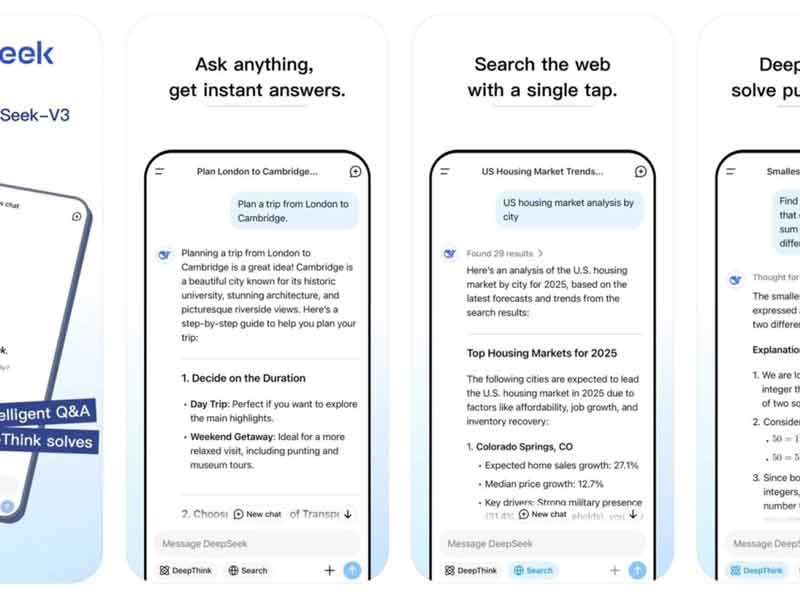
Free web chat: Visit chat.deepseek.com, create an account, and start typing, no payment required for standard use. This is the simplest entry point for anyone just wanting to try the model out before considering any kind of API integration or paid usage.
API access: Sign up at platform.deepseek.com for API access, which comes with a free 5 million token grant for new accounts. Because the API is OpenAI-compatible, integrating it into an existing tool that already uses OpenAI’s API format is usually a matter of changing the base URL and model identifier.
Running it locally: DeepSeek’s models are open-weight, meaning technically capable users can download them and run them on their own hardware.
This requires a genuinely powerful GPU setup for the larger models, Python, and familiarity with tools like Ollama for a more manageable local deployment experience. Smaller distilled versions of DeepSeek’s models exist specifically to make local deployment realistic on more modest hardware, trading some capability for dramatically lower resource requirements.
Can You Invest in DeepSeek?
DeepSeek remains a privately held company as of 2026, there is no publicly traded stock, and no stock ticker symbol exists for it on any exchange. Claims or “guides” suggesting otherwise are inaccurate.
Investors interested in exposure to DeepSeek’s growth indirectly sometimes look at AI-focused ETFs that hold stakes in companies across the broader AI sector, though this offers only indirect, diluted exposure rather than direct ownership.
Worth noting: reports emerged in late July 2026, initially covered by Fortune, that DeepSeek had told backers of a funding pause following a wave of viral social media posts.
As of this writing, this remains a developing story from a single primary source rather than a confirmed, widely corroborated event, worth following through established tech and financial news outlets rather than treating as settled fact until more outlets independently confirm the details.
Common Misconceptions About DeepSeek
“DeepSeek has a more recent training dataset than ChatGPT, so it’s always more accurate.” This claim shows up often but isn’t a meaningful or verifiable comparison, both companies update their models on their own schedules, and “more recent” doesn’t translate directly to “more accurate” for any given task. Accuracy depends far more on the specific task, prompt, and model version than on which company last updated their training data.
“DeepSeek is always cheaper for everything.” It’s dramatically cheaper per token at the low end, but the price gap narrows considerably against competitors’ cheaper tiers, and raw token price isn’t the only factor that determines total cost for a given workload — retries, error handling, and integration effort all factor into real-world cost too.
“You can buy DeepSeek stock.” DeepSeek is privately held with no public listing. Anyone suggesting otherwise is mistaken or describing indirect ETF exposure, not direct ownership.
Quick Reference Checklist
- Confirm which model tier fits your use case: V4 Flash for volume/cost efficiency, V4 Pro for maximum capability
- Check DeepSeek’s official pricing page for current rates before budgeting a production workload
- Test actual latency and reliability for your specific workflow, not just benchmark scores
- For sensitive data, consider local deployment of open-weight models instead of the hosted API
- Use the free 5M token developer grant to evaluate before committing to paid usage
- Don’t treat unverified funding or business news as confirmed without corroboration from multiple sources
Frequently Asked Questions
What is DeepSeek AI? DeepSeek is a Chinese AI research company that builds large language models, offering a free web chatbot, a developer API, and open-weight models. It’s known for using a Mixture-of-Experts architecture and pricing its models significantly below most Western competitors.
Who owns DeepSeek? DeepSeek was founded in 2023 by Liang Wenfeng, who also co-founded the Chinese hedge fund High-Flyer Capital Management. DeepSeek began as an internal AI research lab within High-Flyer before spinning off into its own company, with High-Flyer remaining an investor.
Is DeepSeek better than ChatGPT? Not universally. DeepSeek offers a significant price advantage per token, especially for high-volume workloads, but it isn’t consistently the top performer on every benchmark. The right choice depends on whether your priority is raw cost efficiency or maximum reliability for complex, agentic tasks.
How much does DeepSeek cost? DeepSeek-V4 Flash costs $0.14 per million input tokens and $0.28 per million output tokens. V4 Pro costs $0.435 per million input tokens and $0.87 per million output tokens. Cached repeated content is billed at a much lower rate automatically, and the web chat interface is free.
Is DeepSeek safe to use? For general, non-sensitive use, the practical risk profile is comparable to other major AI chatbots. Since DeepSeek is a Chinese company, data sent through its hosted service is subject to its data-handling jurisdiction, a genuine consideration for sensitive or regulated data. Running its open-weight models locally avoids this entirely.
Can I buy DeepSeek stock? No. DeepSeek is a privately held company with no public stock listing or ticker symbol as of 2026. The only indirect option is investing in broader AI-focused ETFs, which offer diluted exposure rather than direct ownership.
What happened to DeepSeek in January 2025? DeepSeek released its R1 reasoning model, which rapidly became the top downloaded app in the US App Store and triggered a sharp selloff in US tech stocks.
The reaction was driven largely by DeepSeek’s claimed training cost of roughly $5.58 million, which raised questions about whether the AI industry’s assumptions about compute spending were accurate.

Great article! Thanks for sharing this valuable information. I learned a lot.