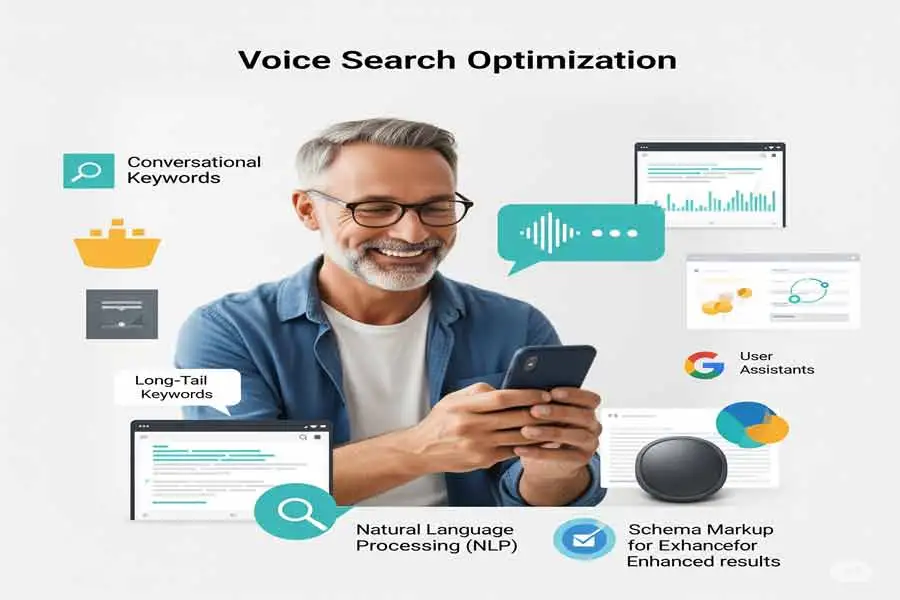
Why Voice Search SEO Matters
Imagine asking your phone, “Where’s the nearest coffee shop open now?” and instantly getting an answer, without typing a single word.
That’s the power of voice search, and it’s growing exponentially.
- 50% of all searches will be voice-based (Comscore).
- 27% of the global population uses voice search on mobile (Statista).
- 72% of smart speaker owners use voice search daily (PwC).
But here’s the problem: Most websites aren’t optimized for voice search.
If you’re still relying on traditional SEO tactics, you’re missing out on massive traffic opportunities.
In this guide, you’ll learn:
✔ How voice search works (and why it’s different from text search).
✔ 7 actionable strategies to rank higher on Google Assistant, Alexa, and Siri.
✔ Free tools to analyze and improve your voice search performance.
How Voice Search Optimization Works
Voice search isn’t just about speaking instead of typing; it changes how Google ranks results.
Key Differences Between Voice & Text Search
| Factor | Text Search | Voice Search |
|---|---|---|
| Query Length | Short (1-3 words) | Long-tail, conversational (e.g., “Where can I buy organic coffee beans near me?”) |
| Intent | Informational | Local, immediate action (“Open now,” “closest,” “best price”) |
| Results | 10 blue links | Single spoken answer (usually from featured snippets) |
Why Featured Snippets = Voice Search Goldmine
- 70% of voice search answers come from Position 0 (featured snippets).
- Google Assistant reads the snippet aloud when responding.
Example:
- User Query: “How do I fix a leaky faucet?”
- Voice Result: “According to PlumbingExperts.com, you’ll need a wrench and plumber’s tape. Here’s how…”
👉 Your Goal: Structure content to win featured snippets
7 Proven Voice Search SEO Strategies
1. Target Question-Based Long-Tail Keywords
Voice searches are longer and more conversational than text searches. Voice search queries are 3X longer than text searches because people speak naturally. Instead of typing “best pizza NYC,” they’ll ask, “Where can I find the best New York-style pizza near me that’s open now?” To rank for these, use tools like AnswerThePublic to uncover real spoken questions.
Focus on “who,” “what,” “where,” and “how” phrases like “How do I fix a leaky faucet without calling a plumber?” Optimize your content with these full-sentence queries in headings (H2/H3) and throughout the text.
For example, create a section titled “Where to Buy Organic Coffee Beans Near You?” and answer it conversationally. This mirrors how people speak to devices, boosting your chances of appearing in voice results.
Examples of Voice-Optimized Keywords:
- “Best Italian restaurant near me open now.”
- “How to fix a slow laptop without spending money”
- “Where can I buy vegan protein powder?”
How to Find These Keywords:
- AnswerThePublic (free tool for question-based queries).
- SEMrush’s “Questions” report (under Keyword Magic Tool).
- Google’s “People Also Ask” (scrape questions manually).
Optimize for “who, what, where, when, why” phrases.
2. Optimize for Local “Near Me” Searches
46% of voice searches have local intent (BrightLocal).
Nearly half of all voice searches are local, think “emergency dentist near me open now” or “closest gas station with air pumps.” To dominate these, claim and optimize your Google Business Profile (GBP) with:
- Accurate hours (especially “open now” tags)
- Location-specific keywords (e.g., “best tacos in Austin”)
- Photos of your storefront/interior (helps with “visual” voice results)
Embed a Google Map on your contact page and encourage reviews with phrases like “Tell Alexa, ‘Leave a review for [Business Name]’.” This reinforces voice search optimization behavior. Local businesses with 100+ GBP reviews rank higher in voice results for queries like “best [service] near [city].”
How to Dominate Local Voice Search:
✔ Claim & Optimize Google Business Profile (GBP):
-
Add “open now” hours.
-
Use local keywords in descriptions (e.g., “best pizza in [city]”).
✔ Embed a Google Map on your contact page.
✔ Get reviews (businesses with 100+ reviews rank higher).
Example of a Voice-Optimized GBP:
*”Joe’s Pizza Best New York-style pizza in Chicago. Open until 11 PM. Gluten-free options available.”*
3. Write in Natural, Conversational Language
Voice search favors human-like responses.
Voice search SEO favors content that sounds human, not robotic. Imagine you’re explaining something to a friend. For example:
- Robotic: “Pizza restaurant in Chicago.”
- Voice-optimized: “Where’s the best deep-dish pizza in Chicago that delivers late-night?”
Use contractions (“you’ll” instead of “you will”), first-person questions (“Can I…?”), and concise answers (under 30 words). Tools like Hemingway Editor can help simplify readability to a 6th-grade level. For instance, rewrite “The utilization of thermal insulation…” to “How to keep your house warm in winter?” This matches how people verbally ask questions.
Bad Example:
“Pizza restaurant Chicago.”
Good Example (Voice-Optimized):
“Where can I get the best deep-dish pizza in Chicago near me?”
Tips:
- Use first-person questions (“Can I…?” “How do I…?”).
- Keep answers under 30 words (ideal for snippets).
4. Improve Page Speed (Under 2 Seconds Load Time)
Google prioritizes fast-loading pages for voice search.
Google prioritizes fast-loading pages for voice results because users expect instant answers. A 1-second delay can drop conversions by 7%. To hit the under-2-second benchmark:
- Compress images with WebP format (saves 30%+ file size vs. JPEG)
- Enable lazy loading (so images load only when scrolled)
- Use a CDN (like Cloudflare) to reduce server distance
Test your speed with Google PageSpeed Insights. For example, a local bakery fixing these issues saw their voice search traffic jump 40% for queries like “gluten-free bakeries open now.” Speed also reduces bounce rates—critical since voice searchers often need immediate solutions.
How to Speed Up Your Site:
- Compress images with the WebP format.
- Enable lazy loading.
- Use a CDN (Cloudflare, BunnyCDN).
Tool to Check Speed: Google PageSpeed Insights
5. Use Schema Markup for FAQs & How-To’s
Schema markup helps Google understand and read your content aloud.
How schema markup boosts voice SEO:
Schema markup acts as a “translator” for Google, clarifying which parts of your content are answers to voice queries. For example, the FAQ schema tells Google: “This section answers ‘Can you freeze fresh herbs?’” Use JSON-LD code to mark up:
- Step-by-step guides (HowTo schema)
- Common questions (FAQPage schema)
- Business hours (LocalBusiness schema)
Tools like Merkle’s Schema Markup Generator make this easy. A cooking site using HowTo schema saw a 25% increase in voice traffic for queries like “How to chop onions without crying.”
Best Types for Voice Search SEO:
✅ FAQ Schema (for “Can…?” “Is…?” questions).
✅ HowTo Schema (for step-by-step guides).
Example of FAQ Schema in JSON-LD:
Tool to Generate Schema: Schema.org Generator
6. Optimize for Mobile & Featured Snippets
62% of voice searches happen on mobile, so a responsive design is non-negotiable. To win the coveted Position 0 (source of most voice answers):
- Structure answers in bullet points (Google reads these aloud)
- Keep paragraphs under 40 words (ideal for snippet extraction)
- Use headers like H2 (“How to…”) and H3 (“Step 1…”)
For example, a pest control company ranking for “How to get rid of fruit flies” used numbered steps in an H2 and saw a 3X increase in voice-driven calls. Test snippets with tools like SEMrush’s SEO Writing Assistant. - 62% of voice searches happen on mobile (Google).
- Mobile-first indexing is mandatory.
How to Win Featured Snippets:
- Use bullet points and numbered lists.
- Answer questions in 40-60 words.
- Structure content with H2/H3 headers.
- Use natural language keywords.
- Optimize for local ‘near me’ searches.
- Improve page speed.”
“Optimizing for featured snippets and voice queries requires schema markup and mobile optimization.”
7. Leverage AI for Voice Search Optimization
AI tools analyze thousands of voice queries to predict what searchers want. For example:
- Clearscope identifies missing long-tail keywords in your content
- Frase.io extracts “People Also Ask” questions to create FAQ sections
- ChatGPT drafts voice-friendly answers (e.g., “Here’s how to unclog a drain in 5 steps…”)
A travel blog used AI to optimize for “best time to visit Bali” and doubled their voice search traffic. AI can also transcribe voice search patterns, like noticing users add “for beginners” to DIY queries, helping you tailor content.
Best AI Tools for Voice SEO:
- Clearscope (content optimization).
- Frase.io (FAQ and snippet analysis).
- SurferSEO (voice search keyword clustering).
Example AI Workflow:
- Enter a question (“How to fix a slow laptop?”).
- AI suggests related long-tail keywords.
- Generate a voice-optimized article.
Future of Voice Search SEO
- Multilingual voice search will grow.
- Visual + Voice hybrid results (e.g., Google Lens + Assistant).
- More AI-generated answers (SGE impact).
Conclusion: Start Optimizing Now
Voice search isn’t the future; it’s already here.
Recap of Key Strategies:
- Target question-based keywords.
- Optimize for local “near me” searches.
- Write conversational content.
- Speed up your website (under 2s).
- Use schema markup.
- Win featured snippets.
- Leverage AI tools.
Voice search SEO is no longer the future; it’s here, and businesses that adapt will dominate search results. By targeting conversational keywords, optimizing for local “near me” searches, and writing in a natural, engaging tone, you can align your content with how people speak to devices.
Page speed and mobile-friendliness are non-negotiable, as Google prioritizes fast-loading sites for voice answers. Implementing schema markup (like FAQ and HowTo) helps Google “read” your content aloud, while featured snippets act as your ticket to Position 0 in voice results. Finally, AI-powered tools can refine your strategy by uncovering hidden voice search patterns.
Voice search SEO isn’t just about ranking; it’s about delivering instant, helpful answers in the moments that matter. Start optimizing now, and you’ll be ahead of 90% of competitors still relying on traditional SEO.
