The biggest shift in search since mobile and most blogs are not ready
If your organic traffic has dropped over the past twelve months without an obvious reason no penalty, no major ranking changes, no big algorithm update that targeted your niche specifically Google AI Overviews SEO is almost certainly the explanation.
Google AI Overviews are AI-generated answer summaries that appear at the very top of search results, above every traditional organic result, and synthesise answers from multiple web sources before a user clicks anything.
According to eSEOspace’s May 2026 analysis, sites that have not adapted to AI Overviews are experiencing 20 to 40% traffic declines for informational queries.
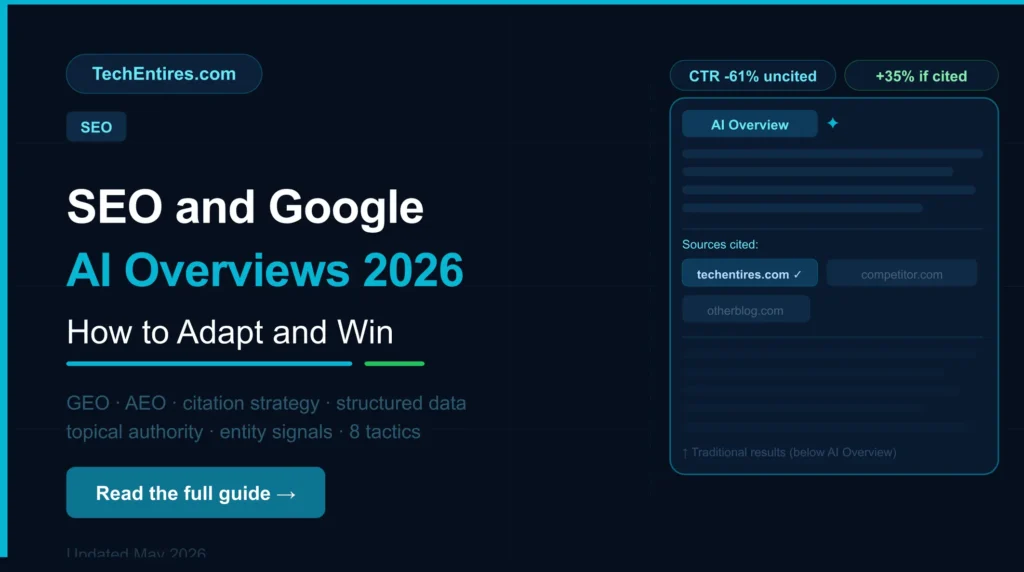
According to QuickSEO.ai’s statistics report from May 2026, AI Overviews cut organic click-through rates by 61% for non-cited pages but brands that are cited inside the AI Overview itself earn 35% more clicks than they did before.
Does Google AI Overviews hurt SEO traffic? For some sites, yes significantly. But the sites gaining visibility and traffic in 2026 are not fighting AI Overviews.
They are optimising for them. This guide covers exactly what AI Overviews are, how they select which sources to cite, what SEO and AI Overviews mean for your blog strategy, and the eight specific tactics that help you get cited rather than bypassed.
Current scale: according to digitalapplied.com’s April 2026 analysis, AI Overviews now cover nearly half of all search queries. For informational, educational, and how-to content the core of most blogging niches the coverage rate is significantly higher. This is not a future trend to prepare for. It is the current reality of search in 2026.
What are Google AI Overviews and how do they work?

Google AI Overviews are AI-generated summaries that appear above traditional organic search results when Google determines a synthesised answer would be more useful than a list of links. First launched broadly in 2024 as part of Google’s search generative experience, they expanded globally and became a standard feature of Google search in 2025 and 2026.
When a user searches a qualifying query, Google’s AI models identify relevant source pages, extract key claims, assemble a synthesised response, and display it with inline citations linking back to the source pages.
The user gets an answer immediately without clicking. If they want more depth, they click through to one of the cited sources which is where the traffic opportunity lies.
As of 2026, Google serves three different surfaces for the same query, according to QuickSEO.ai’s benchmarks:
| Surface | What appears | Click behaviour |
| Classic Search | Traditional blue link organic results | User clicks to visit pages |
| AI Overviews | AI-generated summary with 3-8 cited sources | Most users read summary; high-intent users click sources |
| Gemini / AI Mode | Full conversational AI response | Minimal clicks designed for dialogue not navigation |
The critical SEO implication: zero-click searches have accelerated significantly. Users get their answer from the AI Overview and leave without visiting any website. This is why Google AI Overviews CTR impact on websites has been so dramatic for informational content the first interaction with the information now happens entirely within Google’s interface.
But the picture is not uniformly negative. Sites earning citation placement inside AI Overviews report a different experience: higher trust signals from visitors who do click through, increased branded search volume as readers search specifically for the cited source, and measurably better conversion rates from AI Overview-referred visitors who arrive with more context and higher intent than typical organic visitors.
Which search queries trigger AI Overviews and which do not
Understanding where AI Overviews appear is the first step in building an AIO SEO strategy 2026. Not every query triggers an AI Overview and the variation by industry and intent is significant.
According to WebFX’s 2026 benchmarks, published by Stackmatix in March 2026, AI Overview rates by industry break down dramatically:
| Industry / Content type | AI Overview trigger rate | Strategic implication |
| B2B Technology | 70% of queries | Highest exposure optimising for citations is critical |
| Health and Medical | ~60% of queries | High exposure E-E-A-T signals essential for citation |
| Finance and Legal | ~55% of queries | High authoritative sourcing and author credentials matter |
| General Informational | ~45% of queries | The blogging niche significant and growing exposure |
| eCommerce / Product | 4% of queries | Very low product queries protected from AI Overview disruption |
The critical takeaway for bloggers: informational queries how-to guides, what-is explanations, comparison content, educational articles are exactly the content types that AI Overviews target most aggressively. This is the core content of most blogging niches, including SEO, digital marketing, and WordPress topics. The organic CTR decline from AI Overviews is most acute for precisely the type of content that most blogs are built on.
Conversely: transactional and navigational queries where the user is ready to buy or looking for a specific site trigger AI Overviews far less frequently. Commercial-intent content is therefore more protected from AI Overview disruption than purely informational content.
Practical audit step: open Google Search Console and look at your highest-impression queries from six months ago vs today. If impressions are stable or growing but clicks are declining, AI Overviews are appearing for those queries and absorbing the traffic before users reach your results. This is the signature pattern of AI Overview CTR suppression.
How Google AI Overviews SEO citation selection actually works

How to get cited in Google AI Overviews is the question every content creator and SEO is asking in 2026. The answer is more accessible than most people assume because the selection criteria are largely things good content strategy already produces.
According to stackmatix.com’s April 2026 analysis: ‘Citation patterns have become more predictable in 2026, with sources that demonstrate consistent topical authority earning more stable citation placements. This rewards sustained content investment over one-off optimisation.’
The key factors Google uses to select AI Overview citations:
- Topical authority sites that have published multiple comprehensive, interlinked articles on the same topic cluster are consistently cited more often than sites with one strong article on a topic surrounded by unrelated content. This is exactly the pillar-and-cluster model that drives our internal linking strategy .
- Direct answer positioning according to stackmatix.com: ‘For every target query, ensure your content includes a concise, definitive answer within the first 100 words of the relevant section.’ Google’s AI models extract the most directly answerable section of your content. Content that buries its answer in lengthy preamble is passed over for content that answers first and explains second.
- Entity authority Google’s AI uses entity understanding to evaluate source authority. This means consistent author attribution, structured author bios with credentials, organisation schema markup, and clear topical expertise signals throughout your content. A named, credible author with verifiable expertise is a citation signal.
- Structured data SEO pages with proper schema markup FAQ schema, HowTo schema, Article schema give Google’s AI systems a machine-readable signal about the nature and structure of your content. This makes it significantly easier for the AI to extract citable claims accurately.
- Content comprehensiveness according to digitalapplied.com’s April 2026 analysis: ‘Pages with highest frequency across sub-SERPs get cited. This is why comprehensive content covering multiple facets outperforms narrow, single-keyword pages.’ Google’s AI fans out a query into multiple sub-queries. Pages that answer multiple related sub-queries get cited across more AI Overviews than pages that answer only one narrow question.
The strongest single predictor of AI Overview citation in 2026 is topical authority built through content clusters not individual page quality. A site with 15 interlinked posts on WordPress SEO will be cited for more AI Overviews on WordPress SEO topics than a site with one extremely well-written post on the same topic and nothing else. Depth of coverage at the site level outperforms individual page excellence.
8 tactics to optimise for Google AI Overviews SEO in 2026
These are the specific changes that make content more likely to be cited in AI Overviews ordered by impact. Generative engine optimization is still a developing discipline in 2026, but these eight tactics are supported by observable citation patterns across multiple industries.
Tactic 1: Write a direct answer in the first 100 words of each section
This is the single most impactful change most bloggers can make immediately. Google’s AI models scan your content looking for the clearest, most concise answer to the query. Place your direct answer at the very start of each H2 section before examples, context, or elaboration. The structure should be: answer first, explanation second, examples third.
Before: ‘Crawl budget has been a topic of significant discussion in the SEO community for many years, with different experts holding varying opinions on its importance…’
After: ‘Crawl budget is the number of pages Googlebot will crawl on your site within a given timeframe. It is determined by crawl rate limit and crawl demand. For most sites under 1,000 pages it is not a significant concern.’
The second version is structured as AI Overview citation-ready. The first is not.
Tactic 2: Build comprehensive topic clusters, not standalone posts
Google AI search SEO in 2026 rewards topical coverage at the site level. A single outstanding post cannot match the citation authority of a site that has covered every angle of a topic comprehensively. Build content clusters: a pillar post covering the broad topic, and five to ten cluster posts each covering a specific sub-topic in depth. Every cluster post links back to the pillar. The pillar links to every cluster. This architecture tells Google’s AI systems that your site is an authoritative hub on the topic not just a single-page reference.
This is the same internal linking architecture that improves traditional SEO rankings and it doubles as the strongest AI Overview citation signal available. See the complete guide to building a high-traffic blog with topic clusters .
Tactic 3: Implement FAQ schema on every key post
Structured data SEO is one of the clearest signals you can give Google’s AI that your content is structured for extraction. FAQ schema markup wraps your question-and-answer pairs in machine-readable JSON-LD that Google’s systems can parse directly. Every post we produce at TechEntires.com includes a FAQ section with accompanying schema markup because it serves both traditional featured snippets and AI Overview citation simultaneously.
Add FAQ schema to every post covering a topic that generates question-format queries. The schema tells Google’s AI exactly which questions your content answers and what the answers are removing any ambiguity in the extraction process. The schema markup is included in every article Word file produced in this series.
Tactic 4: Strengthen E-E-A-T signals throughout your content
Google’s AI systems evaluate sources for Experience, Expertise, Authoritativeness, and Trustworthiness before citing them. The practical signals that satisfy these criteria in 2026:
- Author attribution every post should have a named author. Add an author bio block with specific credentials relevant to the topic. A named SEO practitioner with verifiable experience is more citable than anonymous content.
- First-hand examples claims supported by specific real-world examples or personal case studies are weighted more heavily than generic statements. ‘According to our own testing…’ with a specific result is stronger than ‘experts say…’
- Cited sources link to named, authoritative sources for any statistical claim. This signals that your content is research-based rather than opinion-based.
- Content freshness update key posts with current year dates and fresh data. A post last updated in 2023 signals lower reliability for current information queries.
Tactic 5: Answer the People Also Ask questions for your target keywords
Google’s AI Overview often draws content from the same set of questions that appear in the People Also Ask box for a given query. Search your target keyword, expand every PAA question, and make sure your article provides a direct, concise answer to each one. Structure these answers as distinct H3 subheadings or FAQ entries formats that make them easy for Google’s AI to extract independently.
This doubles as an Answer Engine Optimization (AEO) strategy the practice of structuring content specifically to be extracted and delivered as AI answers rather than just ranked as a blue link.
This same extraction-first structure is exactly what voice assistants like Alexa, Siri, and Gemini Live rely on when reading an answer aloud, see our complete voice search SEO strategies guide for the assistant-specific tactics that build on this foundation.
Tactic 6: Use clear, scannable heading hierarchies
AI models extract content more reliably when it is structured with clear, descriptive headings that match the user’s question intent. Every H2 and H3 in your article should be written as a question or a direct descriptive statement not a clever headline or cryptic teaser. Google’s AI needs to understand at a glance what each section covers.
Weak heading: ‘The Next Level of Search’ tells Google nothing about the content below it.
Strong heading: ‘How Google AI Overviews decide which sources to cite’ tells Google’s AI exactly what this section answers.
Tactic 7: Pursue backlinks from authoritative sources
E-E-A-T backlinks remain one of the strongest signals for AI Overview citation eligibility. According to Ahrefs 2026 data referenced in our domain authority guide, sites with over 32,000 referring domains are 3.5 times more likely to be cited by ChatGPT and similar authority patterns apply to Google’s AI Overview selection. Citation in AI Overviews is an authority-first selection process. Building your backlink profile through the link building strategy directly improves your eligibility.
Tactic 8: Track AI Overview visibility separately from traditional rankings
Traditional GSC rankings do not tell you whether you are being cited in AI Overviews. You need to search your target keywords manually and check whether an AI Overview appears and whether your content is cited.
As of mid-2026, tools like QuickSEO.ai, BrightEdge, and Semrush are building AI Overview citation tracking into their dashboards. Set up monthly manual checks for your top 20 target keywords until automated tracking is fully integrated into your reporting workflow.
Track separately: traditional ranking position, impressions in GSC, clicks in GSC, and AI Overview citation presence. The combination of stable impressions with declining clicks is the signature of AI Overview suppression and a signal that citation optimisation should be your priority for that keyword cluster.
The strategic reframe for 2026: stop thinking about ranking number one and start thinking about being the most citable source on your topic. These are related but different goals. Number one ranking gets you a click when the user scrolls past the AI Overview. Being the cited source inside the AI Overview gets you a click and a trust signal before the user has even seen your domain name.
Does Google AI Overviews hurt SEO traffic the honest answer
Does Google AI Overviews hurt SEO traffic? For informational content that has not been adapted, the evidence from 2026 is unambiguous: yes, traffic declines are real and significant. The 20 to 40% traffic decline figure from eSEOspace reflects what is being reported across multiple blogging and SEO communities worldwide.
But the picture has another side. According to eSEOspace’s May 2026 analysis: ‘Brands that appear as cited sources within AI Overviews report higher trust perception, increased branded search volume, and higher conversion rates from the traffic they do receive.’ The traffic that reaches your site via an AI Overview citation is pre-informed.
The visitor already read a summary that mentioned your site. They clicked through because they want more. That is a fundamentally warmer audience than a cold organic click.
The realistic summary for bloggers in 2026: if you publish primarily informational content and have not adapted your content structure, you will continue losing traffic to AI Overviews.
If you adapt building topic clusters, writing direct answers, implementing structured data SEO, strengthening E-E-A-T signals you can both reduce the suppression of your uncited pages and earn citation placement that delivers warmer, higher-converting visitors.
Neither outcome is certain to arrive quickly. Adapting your content strategy for Generative Engine Optimization is a six to twelve month investment, not a quick fix. But the blogs that start now will be the ones with stable or growing traffic in 2027 when AI Overview coverage is likely to expand further.
Adapting existing posts for AI Overview citation is best done through a structured content refresh see our guide on how to rewrite old blog posts for SEO .
Frequently Asked Questions
What are Google AI Overviews?
Google AI Overviews are AI-generated answer summaries that appear above traditional organic search results for qualifying queries. They are part of Google’s search generative experience, launched broadly in 2024 and expanded globally through 2025 and 2026.
When triggered, they synthesise information from multiple web sources into a cohesive answer with inline citations. As of 2026 they cover approximately half of all search queries, with informational and educational content seeing the highest trigger rates.
Does Google AI Overviews hurt SEO traffic?
For informational content that is not cited inside AI Overviews, yes organic CTR declines of 20 to 40% are documented for informational queries in 2026. AI Overviews cut organic click-through rates by 61% for non-cited pages (QuickSEO.ai, May 2026).
However, brands cited inside AI Overviews earn 35% more clicks than before, because citations act as trust endorsements and drive higher-intent visitors. The impact is negative for uncited pages, positive for cited ones.
How to get cited in Google AI Overviews?
The strongest citation signals in 2026 are: topical authority built through content clusters (multiple interlinked posts on the same topic), direct answers placed in the first 100 words of each section, FAQ schema markup, strong E-E-A-T signals including named authors and cited sources, comprehensive coverage of related sub-questions within each article, and authoritative backlinks from recognised sources in your niche.
Citation patterns have become more predictable in 2026 consistent topical coverage is the most reliable path to stable citation placement.
How to optimize content for Google AI Overviews 2026?
Eight tactics work consistently: write direct answers at the start of each section, build comprehensive topic clusters not standalone posts, implement FAQ and Article schema markup, strengthen E-E-A-T with author attribution and cited sources, answer People Also Ask questions for your target keywords, use descriptive question-format H2 headings, pursue authoritative backlinks, and track AI Overview citation separately from traditional GSC rankings. Together these tactics align your content with what Google’s AI extraction systems look for in a citable source.
What is Generative Engine Optimization (GEO)?
Generative Engine Optimization (GEO) is the practice of optimising content to be selected and cited by AI-generated search results including Google AI Overviews, ChatGPT Browse, Perplexity, and Claude.
It extends traditional SEO by adding answer-readiness, entity authority, and structured extraction signals to standard on-page optimisation. GEO is increasingly considered alongside Answer Engine Optimization (AEO) as a core discipline of search strategy in 2026, alongside traditional keyword-based SEO.
How to appear in Google AI search results for my blog?
How to appear in Google AI search results requires building citation authority at the site level, not just the page level. Publish multiple comprehensive, interlinked posts on your core topic cluster. Write direct answers at the start of each section. Add FAQ schema markup. Ensure your author attribution and E-E-A-T signals are strong. Build backlinks from authoritative sources in your niche.
Manually search your target keywords monthly to check whether AI Overviews appear and whether your content is cited then refine the content of non-cited posts based on what the cited sources are doing differently.
Which types of content are most at risk from AI Overviews?
Informational and educational content faces the highest risk how-to guides, definition articles, comparison posts, and question-answer content. B2B Technology content sees AI Overview trigger rates of 70% in 2026, according to WebFX benchmarks.
General informational blogging content sees approximately 45% trigger rates. eCommerce and transactional content is largely protected only 4% of product queries trigger AI Overviews. Commercial-intent content where a click is required to complete a purchase or enquiry is significantly more insulated from AI Overview disruption than purely informational content.
